Interview conducted by ground-breaking, scene-shaping DJ / producer, Noel Watson
It’s early morning on the outskirts of Belfast, just a half a mile or so from the edges of the sprawling Ballybeen Estate, a concrete maze of moderately sized decent family homes, built in the sixties and finished in 1971, designed by Scottish architects. It was a notoriously dangerous place, a reminder of this city’s bad old days.
The place is still rather intimidating, with huge gable-sized politically motivated murals lining it’s most visibly eye catching walls, though these days more a reflection that the old guard are circulating under the surface, than the feelings of the majority of a new generation of people who now represent a changed and peaceful country that’s beginning to find it’s confidence again in today’s modern world.
I’m walking on foot along a path surrounded by quite beautiful and historic countryside. It could be a million miles away from the city, towards an entirely different kind of housing authority, a man with a similar background to my own, and a fellow DJ and producer. In the back of my mind, I have a feeling of a transitional moment, of déjà vu, the baton being passed if one likes… and I have to admit it does feel like this is something I have no control over, or would wish to, and feels right.
I asked Rob at Ban Ban Ton Ton if I could carry out this assignment, as he’d already expressed to me months earlier that he was preparing a piece on my interviewee. I referenced past acquaintances and interviews, where I was being quizzed by Mr Stewart, microphone and steady-cam in hand, and not like today, the other way around – this being the reason for my above sentiments, and most definitely a great excuse for a piece for the blog.
An older DJ, without being condescending, and perhaps a tad nostalgic – Nigo has just reinvented that with a clever line for Human Made’s latest T-Shirt design: The Future Is In The Past – shapes the fundamental stepping stones, the start of how it all intrinsically links, and shares an understanding hopefully in the contemporary light accorded to today’s latest shaker, there has to be a basic respect, it means everything. And so, Timmy Stewart invites me into his kitchen, and prepares lunch.
So yeah, let’s go back to the beginning, and relax. I’m here to talk to one of Belfast’s hottest DJ’s and producers, one half of genre twisting edit duo Black Bones, driving force and organiser of ‘The Night Institute’ one of the cities longest serving club nights alongside his DJ partner Jordan Nocturne, co-curator of Eastside Electronics, part of the Eastside Arts Festival, and standalone artist and producer behind the brilliant Extended Play label and releases.
Timmy likes to talk, a typical Belfast ball of energy, he’s confident and unassuming, he knows his onions, and as my Mum used to say, no goat’s toe. We’ve known each other for many years, not closely, as I relocated to London when Timmy was just beginning school, but over time our paths have crossed on many occasions. As I mentioned earlier, he once very eagerly and excitedly asked to interview me, when I would cross the water to come back home to Belfast to guest DJ at some of the cities great spots. How do you feel? I say, where would you like to start in explaining to me how all of this has happened to you in your life? We laugh, chat away, and decide to let it flow.

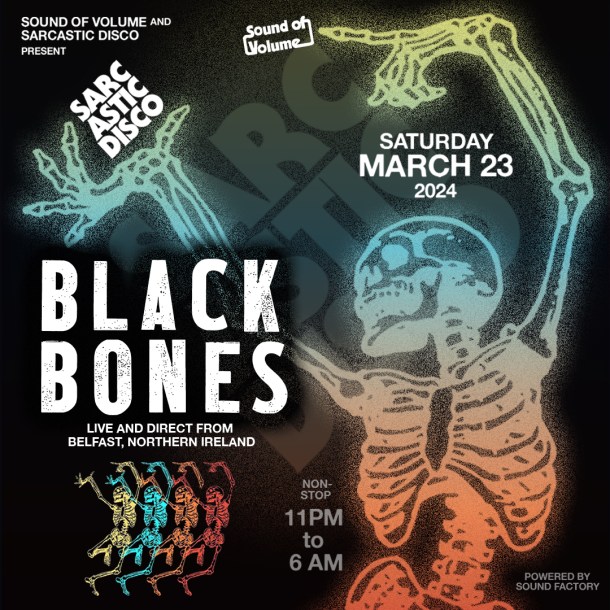
For most of you reading this though, Timmy’s recent endeavours and well overdue exposure to a bigger audience has come via his Black Bones productions and twelves, including a recent digital outing on Optimo’s imprint, and a recent gig in L.A. care of the iconic Sarcastic Disco party in collaboration with Sound Of Volume. So we started with a focus on his relationship with Aaron Black, his partner and collaborator in Black Bones, and an insight to his beginnings as a DJ in Northern Ireland’s musical landscape

Okay. Let’s start with the Black Bones projects, and an insight to how you grew up here and what inspired your love of music?
So with the Black Bones stuff, Aaron Black and I had been friends and music lovers, both of us, through the whole vinyl only pre digital period. That was the only way you could access music then, to buy and collect records. Aaron always had an amazing record collection. In Belfast, I kind of looked at Aaron and Chris Frieze and myself as being those kind of collectors.
How long ago was that?
When I first met Aaron, it would’ve been early 2000. I was working for the clothing company Diesel, and I was running a club night in Belfast called Digital Boogie. We were able to promote the night through the shop, which was pretty handy, as we had loads of young people coming in there. The guy who owned the shop sponsored our nights, I was the denim buyer but I also provided the in-store music … I was kinda always a DJ in the background.
That was really because I grew up with my mum just loving vinyl, my mum would’ve put a record on more than the T.V. So from about eight or nine, I was eventually allowed to put the records on myself. I remember moving the arm over, dropping it carefully down on the groove, this kinda stuff! Every week. My mum went down to the Spin-A-Disc record store on the Woodstock Road in the eastside of Belfast to buy new albums. She just loved music, she’d a real hunger for something new, so she would’ve gone in and had conversations about what had been released, bought Depeche Mode, UB40, Blondie albums, everything around that time, but also Beach Boys, Bowie LP’s and more.
My mum also told me about going to Kelly’s (the nightclub in Portrush that became one of the first and only super club Lush nights in Northern Ireland during the `90s rave heydays). She would’ve gone to see bands in Kelly’s `70s/80s era, and her telling me it was always the place to party.
So, because of my mum, I had this real love of vinyl. There was always a record collection around me, so it wasn’t really a big surprise to my mum that I went on to start collecting my own stuff. It was tapes at first, because there were always records in my house, meaning I didn’t feel the need to buy them initially and I didn’t have a lot of money. So firstly it was all the electro series tapes. We used to go to Connswater (shopping mall in Belfast) and buy Street Sounds and all that kind of stuff.
So I had my tape collection and a wee ghetto blaster when I was really young. Progressing to start buying things like the odd seven inch single when my mum would’ve been going to the record shop. And then I would’ve been buying all my own records. So she’d be buying an album and I’d be getting a seven”, 12” and just starting off collecting. So I had quite a decent collection by the time I was in my teens. Then basically I crossed paths with other people who were collectors. So it would’ve been Chris Frieze and then eventually Aaron, which was in the early two-thousands.

Black Bones by Chad Alexander
How were you introduced?
Aaron’s sister’s now husband Johnny, worked with me in that Diesel store and he said “I think you need to meet my partner’s brother, he’s like you, really into music, and he’s just come back from Uni in Scotland and regularly been down at the Optimo nights, I think you’d get on”. He told Aaron the same, so Aaron made me a mixtape. I remember it being so broad, in terms of there was really good dance music, but then there was also really good music by bands, with an ESG/Liquid Liquid kind of feel and I thought this guy is in into a lot of stuff that I really love.
So eventually we were introduced, I was DJing somewhere, and Aaron came down and I said I really love that tape, it was brilliant. And then I was asking about certain tracks on it. I said, I’ve got this, I’ve got that. What was that? And we just got on like a house on fire.
We’ve been friends for years, talking about different types of music. We’re not into exactly the same thing, but there is this kind of middle ground where we meet. And then someone said why don’t you guys make music together? You know, because you just obviously do have this kind of common ground that you both share.
So we went into the studio years ago after Aaron came to me with a track he thought we could do an edit of. And so we did a kind of Afro thing, and we did two versions. One was like a dub where we added some acid and I think that’s when we really started finding our feet working together.
I had an old record that my mum had given me, which was Demis Rousso’s album and it had this track I always loved, but thought it was too short with a crushed arrangement, I felt it had potential to be this big Balearic 7-8 minutes long track and Aaron agreed. So we were starting to hear things the same way.
We suddenly had these four edits together and they felt like a combined forces thing. I sent them to my friend who runs a distribution company, who liked them and was happy to press. Those 4 edits became the first Black Bones record.
Where did the name come from?
Aaron’s surname is Black, and everyone had called me T-Bone
What year was that? The first black Bones record?
I think it was around 2017.
You had been a stalwart of the Belfast DJ scene during that time as well though, hadn’t you? What were the first nights and clubs like here for you?
Well my first gigs were in Kellys and then at the Art College, the club nights that came after Sugar Sweet. I was a young clubber, when I was 16,17 I was going to Face, then I started going to the Sugar Sweet nights a lot, and really fell in love, and got properly schooled by how David (Holmes) and Iain (McCready) were doing things. They were playing really good house and techno, they were a massive influence in the early days.
I always loved the Art College nights, going from 80bpm up to 130bpm, they built the night around the people as they arrived. They brought the night up with the vibe around the room and I realised that’s how it should be done. They created and built the tension, they were masters of creating that tension. That definitely shaped my DJing style, because I play from slow bpms from the start of the night, right through to faster, depending on the size of a room, or the point of the night that I’m playing, on whether it’s indoor or outdoor, etc.

David heard us DJ at an afterparty that myself and a couple of friends had put on – a late night, early morning thing in an old taxi depot after an Art College gig one night. David actually brought Andrew Weatherall with him and a few other people, and we were playing house and techno and he commented to us on the music being really good.
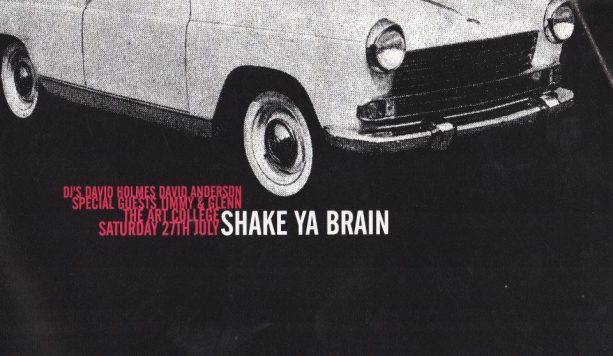
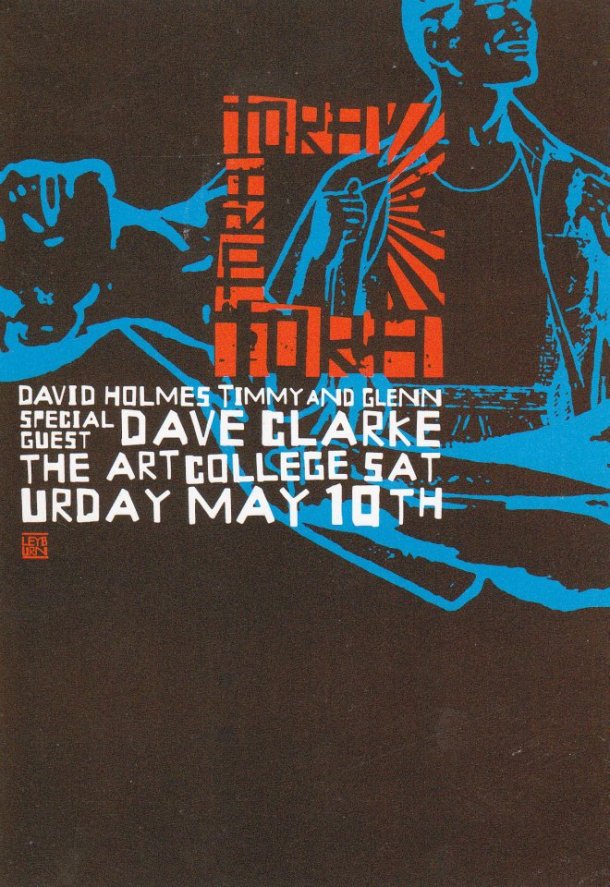
At that point, we were buying our records from Hairy Bear in Belfast and also getting records from Vinyl Underground on Portobello Road in London (Authors note: coincidentally my brother Maurice worked here occasionally in the basement record store alongside Tosh at this time) and were getting white labels of everything. So we were really enthusiastic then one night David commented “I think you should come play for me sometime”. My friend Glenn and I, who were DJing together ended up playing at Shake Ya Brain and then Tora, Tora, Tora a few times.
Tora Tora Tora, what was that? David Holmes’s next club venture?
That was David’s and Davey Anderson’s club, as was Shake Ya Brain. We were kind of going there a lot, then we got breaks at those nights. That would have been the late `90s.
How did you get from running your own club nights to working with Aaron?
I went on to run Digital Boogie and other club nights across the city afterwards.
I was always known as the house head in our crew, but always collected different music and had other influences, so I suppose Aaron and I DJing together became more eclectic. Providing a chance for me to step outside of being straight up dance music and playing some types of the music I’d collected around the world.
Did you and Aaron run your own club night together?
No, we’ve never really done that. But after the records, we started to get people interested in hearing us play together a bit more. Aaron and I would play dub reggae right up to house, post-punk, breaks, techno, industrial & NuBeat. And I think there’s a real art to doing that, but you have to be careful that it doesn’t sound like a dog’s dinner, more joining the dots, but you do have this freedom to move around a lot more. And when I think about the Black Bones thing, to me it’s a very European sound. The Black Bones E.P.s are well received around Europe, Germany, the Netherlands places like that, a different kinda feel.
How long did it take to reach that sort of level with the records?
We started doing about three to four twelve inches a year. There were always four tracks on each record. We put out 12 edits within the first year as I’m pretty sure the first three releases came out that same year. There’s only seven records in total in the series. That created the opportunity for people to say ‘we would love to hear you guys DJ. They’d heard these records and love to hear what you actually play’. We did always think this would go down well in some little dingey club somewhere in Europe. We always love a dark room, red light, like a basement with no windows. We always think that’s a Black Bones kind of feel.

The whole re-edit world is huge now, as you know. How did you get on with that scene?
I think the main thing with Aaron and I know is we would get bored really easily if we became known for only one style. No disrespect to anyone who does love that thing. You know, there’s people like Soundstream, who are just brilliant at doing disco things and flipping them on their head for today’s floors. Don’t get me wrong, we do like a bit of that. But we are always asking each other… ‘Have you heard this dub track? Have you heard this old disco thing? Have you heard this old Chicago number?’ And the thing is that’s what we get excited about. So I do think that did come through in those edits. The only thing that didn’t really come through was our love for the post-punky kind of industrial sounds that we both really adore.
In the edits world at that time, tracks that were doing well were disco, Afro-disco and Balearic. So, when we were letting the distributor hear the more industrial style edits we had created, they were cherry-picking disco and house tracks out as being ones with the strongest appeal. They were right, but it meant that one side of Black Bones wasn’t being represented. But it was a process the distributor was involved in, and it was to our benefit because they had the knowledge of what sells well and wanted the label to do well. Then ironically, four of the more industrial sounding edits that got skipped over were released more recently, even though we had made them years beforehand.
But that’s the thing, if you find a good record, it’s kind of timeless in a way. It doesn’t matter where it’s from or when it’s from. Does it still sound exciting? Does it still sound good? I think as DJs and as producers, that’s what we’re drawn to. That’s what keeps it interesting for us. So if we had a successful record and it was of a certain sound and people were to say, ‘that’s your sound now, you need to do that forever’ I think we would pack it in because that wouldn’t be exciting for us.
The Black Bones edit series ended after the seventh release, do you have any plans for any re-releases or even new edits and will you continue with Aaron as Black Bones?
We have just started doing some more edits, with those four older edits released through Duca Bianco recently. The thing about the edits is they don’t often live in the digital world. They don’t reside on Bandcamp, we didn’t want do that. So if you didn’t get the records, you can’t find them anywhere else. We didn’t overly like the idea of repressing either. So that series, that’s part of the Black Bones story, those seven records are not going be added to.
The new release on Chris Frieze’s Mystic Arts Label is a Black Bones production, but new original material?
They’re originals, even though there’s some samples going on. But we haven’t taken a track that exists and carved it up into something. We’ve built stuff from the drums up.
Aaron and I both really love sampling. We always talk about when the sampler became a big part of the dance music world and those records, we still love those records. We love the sound and the grit and the feel and the swing and everything that you get from samples. It’s quite hard to produce that a lot of times when you’re just starting with cleaner instruments. So yeah, sampling will always play a part for us.
But these original records that we create, even though they might have samples in them, we use them creatively. We aim to make them their own entities, this record for Chris, the Mystic Arts one is, is a tribute or a love letter to those nineties break beat records that we love, African Head Charge, Renegade Soundwave that kind of thing. We still listen to some of those records and think ‘They’re so ahead of their time. So fresh. They’re still good to go’.
They still sound contemporary…
They do. You know, there’s something about when people get that right and I think it’s because a lot of times they don’t really have a vision or a plan for it. They just go into the studio and make the music and it turns out a certain way. And it’s all based around personality, inspiration and what they’re feeling at that time… there’s no agenda. You’re not trying to make something that sounds exactly like something that already exists.
I think that’s when all the great records are born over the years. We wanted to do something that was a nod to that (the mid `90s Breakbeat era) but not an edit, it’s like you listen to it and you go, ‘that makes me think of that era, that’s transporting me back there a wee bit’… but at the same time it’s got this kind of weird way of how it’s been put together or the kind of way it flows, the way it’s been programmed.
It’s been lovely to see you today and catch up with all of the happenings and creative influences that help get us through this crazy thing called life!… Lastly just give us some idea of what else to expect from you, I know there’s so much more you’re involved with besides the Black Bones project, what’s the word on the new Night Institute label and release?
The Night Institute, is an arts organisation that has been putting events on for nine years this July, we have just put out the first release on a record label of the same name. Spearheaded by myself and Jordan Nocturne (known for his contributions to labels like Correspondent and Polari) this label aims to showcase Belfast’s independent electronic music scene on an international level.
With the label side we plan to have vinyl and digital releases featuring tracks by both of us, as well as contributions from global artists that get played regularly at the party.
We’re kicking off with a stellar line up, alongside the tracks from Jordan and myself Volume 1 also features guest appearances from Justin Cudmore, resident of New York’s renowned Bunker venue and Scotland’s Hifi Sean, who has been making waves with his collaborative project alongside David McAlmond, as well as working with vocalists such as Ce Ce Peniston and Yoko Ono. With this label, we are working to a mantra of “Good vibes for uncertain times”.

A big thank you to Timmy and to Noel. For a review of that new Night Institute E.P. please check this month’s Looking For The Balearic Beat – Rob
Discover more from Ban Ban Ton Ton
Subscribe to get the latest posts sent to your email.
 Ban Ban Ton Ton