
Ele-King is a Japanese publishing house. They’re behind countless books, most of them art, cinema or music related. They have their own magazine and another thing that they do from time to time is put together “disc guides”. These are fairly hefty tomes that aim to be comprehensive samplers of a given genre. These guides themselves are kind of collectable, and when you walk into one of Tokyo’s smaller, more specialist records stores they are likely to have a few of these, and similar texts from rival outfits such as Disk Union, shelved behind the counter for reference.
I’ve bought a few of them – those focused on Ambient, IDM and House. They`re packed with pictures of album sleeves, and brief descriptions, with releases broken down into years and sub-genres. I can’t read much kanji but it’s interesting to see how they join the dots, and the obsessive in me, of course pours over the pages going “got, got, need, got.” The books also contain essays and the odd interview, with relevant artists, reproduced from the Ele-King magazine.
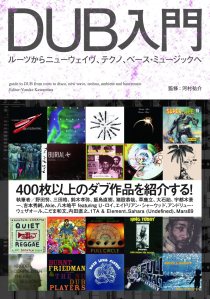
Last autumn saw the release of DUB入門 (“Introduction To Dub”). The chapters work their way from Jamaican roots, through to UK producers like Dennis Bovell, labels like New York’s Wackies, then post-punk, digital, Jah Shaka, rave, the Bristol sound, electronica, Basic Channel, post-rock, dubstep and current innovators like Om Unit, Seekersinternational and Jay Glass Dubs.
As the book proceeds, it becomes apparent that the task they’ve set themselves is far too difficult – since dub now influences pretty much all underground music. It’s way too hard to keep tabs on every offshoot. However, they give it a great shot, and my questions over their choices past the middle pages could simply be due to the frequency of me shouting “got” dropping off.
The interviews include conversations with U-Roy, Adrian Sherwood, Japanese reggae / dub veterans Kazufumi Kodama and Naoyuki Uchida and Andrew Weatherall. The latter came as a complete surprise, I had no idea it was in there until I got the guide home. Originally published in Ele-King Volume 32, in 2000, the interview was conducted by top Japanese music journalist Tsutomu Noda, and translated from the English by Kyoko Uesugi.
Since today would have been Weatherall’s 62nd birthday, for English-speaking fans and fellow obsessives, I’ve translated the interview back again, and reproduced it here.

How would you describe dub today?
Dub was the first music to use the studio as an instrument. Back in the `70s it was a brand new thing. These days, with the development of technology, it`s so easy to experiment with echoes and delays, for example. Not only that, the technology is also way more advanced, and that’s opening up loads of new possibilities… so dub is continually evolving, and appearing in all sorts of new situations.
In the past, it was far more difficult. You had to build your own machines, and to do that you had to have some serious love for mathematical knowledge (laughs)… before being a musician, you had to be a technician. King Tubby, for example, was a technician, a sound engineer, first and foremost, but his experiments with sound created a new form of music.
What was your introduction to dub?
I learned about dub through punk. I read an interview with John Lydon in a magazine where he said that he liked reggae and dub… so I followed his lead. That was in 1977. I was 14. The generation above me was all about bluesy, prog rock, bands like Yes, and concept LPs. The lyrics all seemed to be about fairy tales, demons and dragons. I wasn’t interested in any of that. Punk, instead, was singing about the modern world, the day-to-day state of the UK. Punk was my music. So, John Lydon got me into reggae, which is a totally different style of music to punk, but it shared the same spirit. I found that music by people like Big Youth and Dr. Alimantado was concerned with the same reality as punk… and that was very different to prog rock’s fairy tale stuff.
I was born in the suburbs, and back then there weren’t any black people in my neighbourhood. I’d never been exposed to black culture. The first reggae record I ever bought was a “Big Youth” album. It was an important day for me. Seriously, you could say that it changed my life.
What do you think of that Big Youth record?
I was drawn to reggae from there. I used to listen to a lot of Culture too. Right away, I started buying loads 7” singles, and I became obsessed with the “versions” on the b-sides. I was, basically, hooked on the dubs.
What did you think of reggae’s message?
I think that’s one thing that punk and reggae had in common, that they were political music. Jamaican DJs were “toasting”, throwing out sharp messages over those B-side versions. They weren’t singing about political ideas, more about their daily struggle. About their daily dealings with society and their everyday lives. The absolute opposite of prog rock’s fantasy world.
What is your opinion on Rastafarianism?
I hate all religion, so it’s very difficult for me to comment. I don’t really know anything about Rastafari, but there are times when people need spirituality. That’s something that organised religion can provide, but that can come with a lot of negatives in my opinion.
Black people have been treated very badly in the UK, especially during the punk era… Portrayed in the media as criminals… the bad guys. There was a lot of racism about. I think that, at the time, Rastafari gave black British youth a way to learn about their history and regain their dignity. Black spirituality has a twisted relationship with Western civilisation. Kidnapped from Africa, sold into slavery, forced to convert to Christianity… they needed something to help them regain their pride. That said, I don’t believe in any god. I like reggae a lot, but I’m not pro-religion.
What do you think about the concept of “Babylon” as Rasta calls it?
The concept of Babylon is interesting. Babylon, in my mind, is corporate society. Bullshit big business. I’m not a Rasta, so I don’t ever use the word Babylon, but I think it’s the same corporate society that I’m rebelling against. Rasta use the word Babylon to describe the ills of society. I’m from a middle-class background, but I could relate to that message. Rastafari says that Babylon is a brainwashing system, and I totally agree.
You still play a lot of reggae and dub don’t you?
Yes, I do. Even if I am spinning house, it’s strongly influenced by dub. It all has deep, heavy bass.
What do you find most appealing about dub?
I guess I’m attracted to the ability to lose yourself in it. I think that music like house, techno, hip-hop… is all an outgrowth of dub. There’s a lot of depth to that kind of music. It’s very layered.
Reggae musicians in the 1970s were fearless, flaunting their ganja smoking on their album sleeves.
(Dr Rob Note: Japan’s drug laws are draconian. There is zero tolerance, prison sentences for possession, after which it’s pretty much impossible to get a job or any kind of loan.)
(Noda-san Note: Weatherall was smoking weed during the interview.)
Yeah. Rastas believe that ganja is the herb of God. The white middle class have their wine. Rasta have their ganja.
What do you think of the UK dub scene?
I don’t know much about UK digital reggae and dub these days, but I know Manasseh are good.
Jamaican dub’s heyday ended in the early 1980s, but many consider its spirit, the art, to have been taken up by the UK. In fact, there are now dub artists all over the world, The Netherlands, here in Japan. Also people like Adrian Sherwood have developed dub into something very different.
I have a tremendous amount of respect for Adrian. Sometimes there are extreme purists in the dub crowd who think things have to be in the original dub style, but I’m more in favour of those who spread dub’s influence to other genres. I think Adrian is a true innovator.
The music you make as Two Lone Swordsmen is not typical dub, but there is, for example, a release of yours called “Stockwell Steppas”. Steppas being a reggae term, and Stockwell being a place in South London, near Brixton, somewhere that has a large Jamaican and Caribbean community.
It’s more of a dub influence, than dub itself. I was actually living in Stockwell when I was working on those tracks. There are a lot of Rastas in Stockwell, and a big hip-hop community. I just came up with the name when I was looking out of the window. It’s meant to be a fictional gang.
King Tubby’s dubs are said to be the root of modern remixing. You, yourself have had a long career as a remixer. Do you consider what you’re doing related to King Tubby’s work?
Yeah. King Tubby is definitely at the root of what we do. He created new tracks by reassembling existing ones. I think that’s exactly the same process as a remix.
I think dub is a trippy sound, but there are a lot of trippy sounds around today. What do you think makes dub unique?
Dub is definitely trippy… but there is always space. In trance music, for example, there’s no space. It’s extremely busy. Every space is filled up. It’s too much, but you can jump into dub’s space, and can find a place to lose yourself.
Who is your dub hero?
King Tubby. Adrian Sherwood. If I can only choose one, then I would pick Adrian, without hesitation, because he’s the person who, musically, has influenced me the most. I still get nervous when I meet Adrian. I feel like I’m 14 years old all over again (laughs). Listening to his records, when I was still a teenager, I never guessed that I’d get to meet him.
So, I’m sure the first version of “Fade Away” you heard was the one with Ari Up singing – not the Junior Byles’ original?
Yeah! That’s right!
We are from the same generation. What was the first On-U Sound record that you bought?
It was “Fade Away” (laughs). I really liked the first New Age Steppers album.
That was my first ON-U record too.
(Weatherall laughs)
DUB入門 is published by Ele-King Books.
The best place to currently pick up a copy is – unfortunately – amazon.co.jp.
Discover more from Ban Ban Ton Ton
Subscribe to get the latest posts sent to your email.
 Ban Ban Ton Ton