
To the west of London was Boy’s Own. A collective based around a core of four friends, Cymon Eckel, Terry Farley, Steven Mayes, and Andrew Weatherall, from the Berkshire suburbs of Windsor and Slough. Brought together by a passion for fashion, football, music, and taking the piss. Farley and Weatherall met in “the only decent clothes shop in Windsor”, Catermas, which was run by another key Balearic Beat player, Johnny Rocca (1). All those mentioned were known faces on the soul / rare groove circuit, and regulars at West End venues such as The WAG Club, and events like Le Beat Route and The Mud Club.
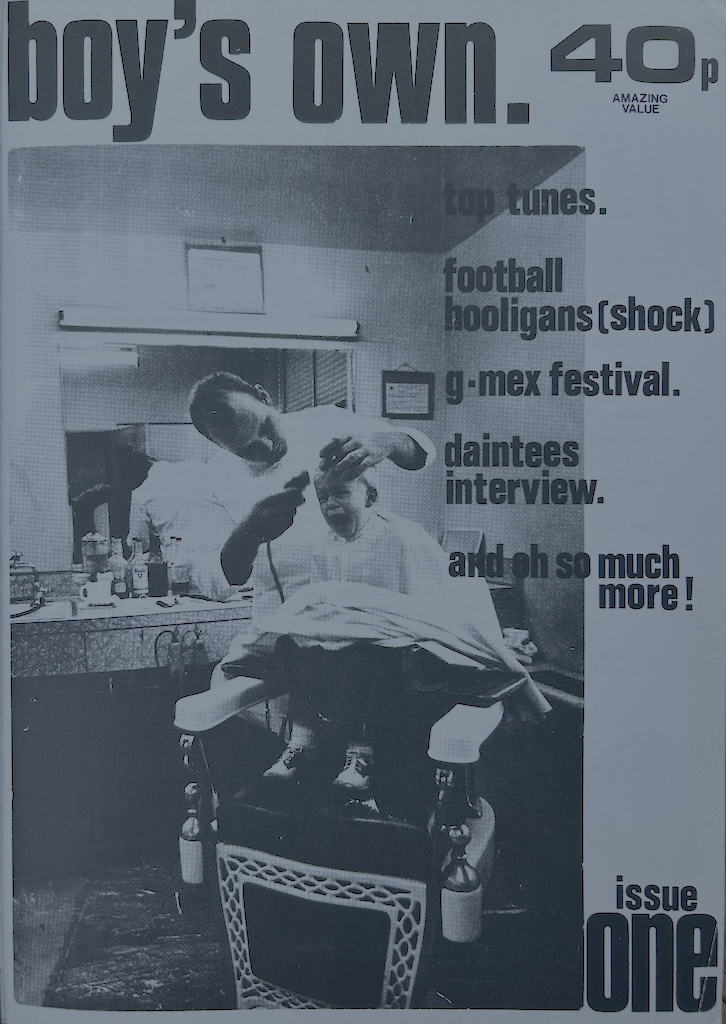
The first thing that Boy’s Own did was start a fanzine. Beginning in the summer of 1986 as a response to The End, a Liverpudlian ’zine put together by members of the band, The Farm. Initially the publication was aimed at “the boy or girl who one day stands on the terraces, the next day stands in a sweaty club, and the day after stays in and reads Brendan Behan whilst listening to RUN D.M.C.” However, once the friends visited Shoom, the publication, in their own words, became “the village newspaper of acid house.” This was at a point where “Balearic” in London constituted 2 or 3 clubs that only a couple of hundred people were actually aware of. In the scene’s own argot, most of which Boy’s Own seemed to invent themselves, the fanzine would run lists of records, parties, and tongue-in-cheek “uppers & downers” – things that were “in” or “out”. It was never intended to be taken too seriously, and its authors were more than a tad horrified when the publication was treated like a bible for “clued-up” clubbers. The whole point was “get off your arse and do your own thing”, not to sheep-like, saddle yourself with a new set of rules.
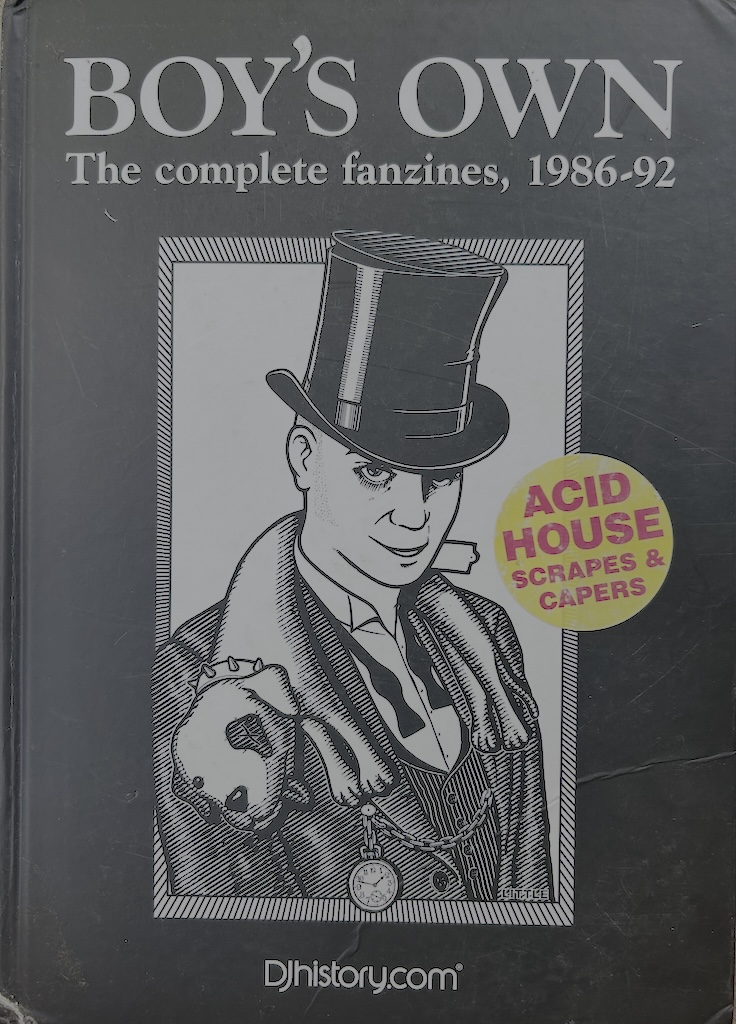
In 2009 the fanzine issues were collected as a hardcover book, and together they do constitute an essential document. Capturing the capital’s enthusiasm as Balearic beat / acid house exploded and mapping how the soundtrack to London’s night life evolved. The “top tunes” featured in the first issue, published in 1986, included hip hop from Def Jam, go-go, rare groove, some house, and pop from bands like The Pogues, New Order, R.E.M., The Smiths and Talking Heads. So pre-Shoom, pre-Balearic beat, and an eclectic spirit was already there.
In ’87 they were predicting a disco revival, but between the summer of that year and the spring of the next Shoom and Future happened, and, instead of Melba Moore LP tracks and impossible to find James Brown 45s, Boy’s Own was now charting the productions of Todd Terry and Tyree Cooper, side-by-side with Euro-pop such as George Kranz’s Din Da Da, William Pitt’s City Lights, and Mandy Smith’s I Just Can’t Wait. The spring ’88 edition also contained an article, written by Paul Oakenfold, titled Bermondsey Goes Baleric (sic). A piece that describes a night out in Ibiza as it moves from the Cafe del Mar to Lola’s to Pacha, to Amnesia and finally to Glory’s. The autumn ’88 charts mixed the Gipsy Kings with house from Chicago, New York, Barcelona, Modena, and Manchester. Those for spring ’89 brought together new music – like the William Orbit remixed Zobi La Mouche, by Les Negresses Vertes and Zanga Zanga’s Oh Ciolili – with old tunes, discoveries from Amnesia playlists – such as Stretch’s Why Did Ya Do It? and Kissing The Pink’s Big Man Restless – and soul / disco favourites – including Tony Rallo’s Holding On and Celi Bee’s One Love – that were found to fit the vibe. By autumn 1989 everything listed was new.
Boy’s Own also threw their own parties. Small, select, word-of-mouth gatherings. Expanding from friends-only soirees at places such as the Cafe des Artistes on Fulham Road, to The Karma Collective, on a farm, in Guilford, and larger adventures – like a party held in a marquee in a field in East Grinstead, and a weekend-long takeover of a holiday camp in Bognor Regis. DJs at The Karma Collective were Steve Proctor, Andy Nicholls, and Weatherall. They had tried to book Danny Rampling, but he refused to shut Shoom for the night. For the East Grinstead party in 1989, they bussed in 400 clubbers from London and Windsor – who walked through woods, and descended into a valley, to the strains of The Cure’s Lullaby. The Boy’s Own logo projected onto the roof of the tent.
While not part of the Boy’s Own editorial team, it was Farley’s close friend Gary Haisman who had introduced the collective to the Balearic beat. Haisman had been clubbing 7 days a week from the minute he could pass for 18. Cafe de Paris, Chaguaramas, Crackers, Louise’s, Ronnie Scott’s, Scamps….he was a regular everywhere and knew everyone. By the mid-80s he was promoting his own events, such as No Sleep Til Brooklyn at Oxford Street’s 100 Club, and The Raid. The latter were nights that he co-hosted with another friend called, Starsky, and it was one of the first London parties to incorporate house into its play-list. The Raid’s resident DJs at that time included Paul Oakenfold and Pete Tong. While holding occasional one-offs and warehouse parties around the capital its regular location was the YMCA on Charing Cross Road – the same basement later used by Shoom. It was Haisman who took the Boy’s Own boys to both The Project Club, in Streatham, and Shoom. who took the Boys Own editorial team to Zigi`s in Streatham, and then Shoom. It was Haisman who made the introductions, provided the connections, fired the enthusiasm and directed the artwork. Together with artist / graphic designer Dave Little he created the iconic “Theatre Of Madness” imagery for Spectrum. Little also drew the iconic Boy’s Own logo, and played a huge part in “branding” Balearic and acid house in the capital.

A photograph of Haisman, sporting a Little-designed Boy’s Own t-shirt appeared in the June 1988 issue of ID Magazine. In an article that focussed on Shoom, Future, and as the magazine labelled them, “The Amnesiacs”(2). It was this photo of Haisman in strobe and smoke fuelled abandon – taken by Dave Swindells, a photographer who more than anyone has documented the scene – that encouraged countless impressionable youths to ask the question, “What the fuck is “Boy’s Own?”, want find out and be a part of it. When Haisman, with D-Mob, recorded the song We Call It Acieeed! he gave the Second Summer Of Love its battle cry.
Terry Farley and another friend, Paul McKee, would sometimes DJ at Demob warehouse parties held on Rosemary Avenue – where the Watson Brothers, Noel and Maurice, would headline. Farley also warmed-up for Oakenfold and Tong at The Raid. Both Farley and Weatherall sometimes manned the club door. While a “soul boy” Farley had a formidable reggae collection, and when Spectrum opened he was booked to spin sets of reggae and dub in the VIP lounge. Farley, keen to join the party on the main floor – allegedly – would sometimes put on an LP and run downstairs. When Spectrum took off, Farley also partnered Nancy Noise, DJing at Future.
A Few Farley “Balearic” Reggae Spins
Althea & Donna / Uptown Top Ranking
King Tubby Meets The Rockers Uptown
Michigan & Smiley / Rub A Dub Style
Pat Kelly / Talk About Love
Prince Lincoln / Old Time Friends
Ranking Dread / Rub A Dub
Ruddy Thomas / Key To The World
Andrew Weatherall was also known for his considerable record collection. In his case, its eclecticism. Referred to locally, again in his own words, as “the bloke with the weird records”, taking in all genres, his DJing, initially, was limited largely to house parties – until Danny Rampling heard him play at an after-hours gathering in a flat off Islington’s Chapel Street – hosted by Starlight Express “star” Bobby “Skater” Collins. It was Chris & Cosey’s October Love Song that secured Weatherall a slot DJing at Shoom. Rampling falling for the trippy tune. Weatherall made his Shoom debut, not at The Fitness Centre, but a one-off out in the country, called Down On The Farm. His fellow DJs were Rampling, Proctor, and Andy Nicholls (3).
Weatherall landing the job at Shoom was a pivotal moment in spreading the Balearic word. Since he was a local face in West London’s suburbs – sometimes working in Windsor’s trendy “boutique” Rafaels – he brought the suburban kids with him into town, while his eclectic sets conversely attracted the London media / fashion / art set back out to his gigs in Berkshire.

When Nicky Holloway started Trip at The Astoria, Farley and Weatherall hosted the “alternative room” in carpeted upstairs Keith Moon Bar. Nicknaming this lounge “Cloud Cuckoo Land”, musically anything went, with Weatherall playing stuff such as Bill Laswell’s Lost Roads (4).
When Shoom moved to Busby’s, the duo took over the second, more chilled out room. Playing reggae, leftfield pop and old soul. Farely rifling through his considerable, enviable collective and pulling out anything that mentioned “ecstasy” (5).
Shoom, Upstairs at Busby’s
James Brown / How Do You Stop?
Dub Syndicate / Ravi Shankar Part 1
Furniture / Brilliant Mind
Cuba Gooding / Happiness Is Just Around The Bend
Happy Mondays / Wrote For Luck
Heaven 17 / Let Me Go
Janet Jackson / When I Think Of You
Mr Mister & MDJ / Broken Wings
Billy Paul / Let Em In
Style Council / Shout To The Top
Eugene Record / Overdose Of Joy
Redd Hott / Ecstasy
Jackie Wilson / The Sweetest Feeling
In London, at least, Weatherall was extremely important in the development of the Balearic beat. While most of his contemporaries were black music fans now desperately hunting down the indie and rock highlights of Alfredo’s Amnesia sets, Weatherall had his own collection of post-punk and electronic funk already. Legend has it that it was Weatherall’s copy of Dizzi Heights’ Would I Find Love that would be rushed downstairs, so that Rampling could play it as a last tune at Shoom. So while most Balearic nights would be rotations of Alfredo’s greatest hits, Weatherall expanded on that list with tracks such as Colourbox’s Looks Like We’re Shy One Horse, Gina X’s No G.D.M., G.T.O.’s Now Is The Time, Torch Song’s Power To Energize, 23 Skidoo’s Coup and the aforementioned Chris & Cosey tune. In the habit of keeping these cuts a secret, he’d cover their labels as they span. Another of his infamous “cockney cover-ups” was Winners & Losers, by Leslie Grantham, the actor who played Eastenders’ “Dirty Den”.
Through 1990, Boy’s Own and their brand (of cool) became associated with a number of weekly central London events. The first of these was the reactivated Raid. After initially closing its doors in 1988, as acid house took off, Haisman, together with Paul Dennis, relaunched The Raid on Friday nights in late 1989, at The Limelight on Shaftsbury Avenue. The Limelight was a deconsecrated church just off Cambridge Circus, and part of a transatlantic chain of clubs owned by New York-based Canadian entrepreneur, Peter Gatien. The main floor at The Raid was presided over by Paul Oakenfold and Steve Lee.

Like Haisman, Farley, all of Boy’s Own, Lee was a supporter of Chelsea Football Club. Meeting the “team” first at football matches, he travelled with Boy’s Own from The WAG Club, to Norman Jay’s Shake & Fingerpop warehouse parties, to Westworld one-offs and then Zigi’s and Future. Visiting Ibiza with them the summer of 1988.

Lee also opened one of London’s first “Balearic-ally” inclined record stores, Phuture, within The Garage, in Lee’s words “at the wrong end of” The Kings Road. His partners in the shop were Boy’s Own’s Steven Mayes and a South London collective, who called themselves Deja Vu. A group of Ibiza / Amnesia / Shoom / Spectrum stalwarts, among them Barry Ashworth, Spencer Guinere, Mark Haggarty, Blaine Scanlan and Sean Slattery, Deja Vu hailed from the outer edges of the city – Addington, Beddington, Streatham, Wallington, and the Roundshaw Estate (6). Much like their northern counterparts, they’d attempted to escape Thatcher’s Britain by bouncing around Europe on their wits. In ’89 they hosted a series of one-offs, including a “Mystery Tour” to Rochester Castle, and sometimes showcasing the band Natural Life (7). The collective also held a weekly Monday night party in Holborn, at Solaris, on the Grays Inn Road, called Monkey Drum, where the DJs included themselves, Lee and Johnny Rocca. Farley and Weatherall were frequent guests, as were John Edis, Andy Nicols and Fabi Paras. Edis worked at Phuture alongside Lee and another DJ named Paul Doherty. The music played explored, and encouraged via connections made at the club, the emerging, heavily Balearic Beat-influenced “dance meets rock” interface.
Monkey Drum Playlist
Happy Mondays / Freaky Dancin’
The Monkees / I’m A Believer
My Bloody Valentine / Soon (Weatherall Remix)
Primal Scream / Come Together (Farley & Weatherall Remixes)
Prince / Lets Go Crazy
St. Etienne / Only Love Can Break Your Heart (Weatherall Remix)
The Specials / Blank Expression
Soho / Hippy Chick
Stone Roses / Waterfall
NOTES
1. Rocca, for example, was a member of Electra, alongside Paul Oakenfold.
2. The photo shoot for the Amnesiac feature also included Lisa Loud, Nancy Noise, Andy Nicolls and Spencer Guinere.
3. Nicholls was the other DJ at Skater Bobby’s Chapel Street party. He tells a story about getting locked out and having to climb a drain pipe, with his records, to get back in.
4. If anybody can remember any other tunes played upstairs at The Trip, please DM me or let us know in the comments.
The story goes that Farley and Weatherall got this gig at the last minute. The bar was supposed to be hosted by a member of Shoom’s inner circle, who was unfortunately arrested a few days before.
5. Farley and Weatherall were also residents, alongside Roger Beard, at a weekly West End party called God’s Disco, hosted by the dancer Michael Clark.
6. Ashworth later formed the hugely successful band Dub Pistols.
7. Natural Life made their live debut at a Downham Tavern all-dayer.
REFERENCES
Conversations with Roger Beard, Paul Doherty, Steve Lee, Liggy Locko, Lisa Loud, and Phil Mison.
Luke Bainbridge’s Acid House: The True Story
Boy’s Own: The Complete Fanzines 1986 – 1992, originally published by DJ History
Bill Brewster & Frank Broughton’s The Record Players
ID Magazine Issue #56, June 1988
The Trip membership snapshot is from Rob Ford’s Members Only.
Discover more from Ban Ban Ton Ton
Subscribe to get the latest posts sent to your email.
 Ban Ban Ton Ton
still see Andy Nichols, he’s still DJing and running his own record shop
LikeLike
Palace Records? I wasn’t sure if he was still there, He would be a good person to talk to. D did you ever go to Monkey Drum?
LikeLike
Again, great stuff Rob
LikeLike