Teo Blake Beauchamp is a writer, professor, and musician from Los Angeles, CA. He earned his MFA in Sonic Arts from Brooklyn College in 2020. Beauchamp serves as Associate Program Director of Sound Thinking NYC, teaches courses at Brooklyn College, Feirstein Graduate School of Cinema, and Montclair State, and contributes to various music publications. Here, he talks to the legendary musician and spiritual teacher, Laraaji, about his new album “Openness”.
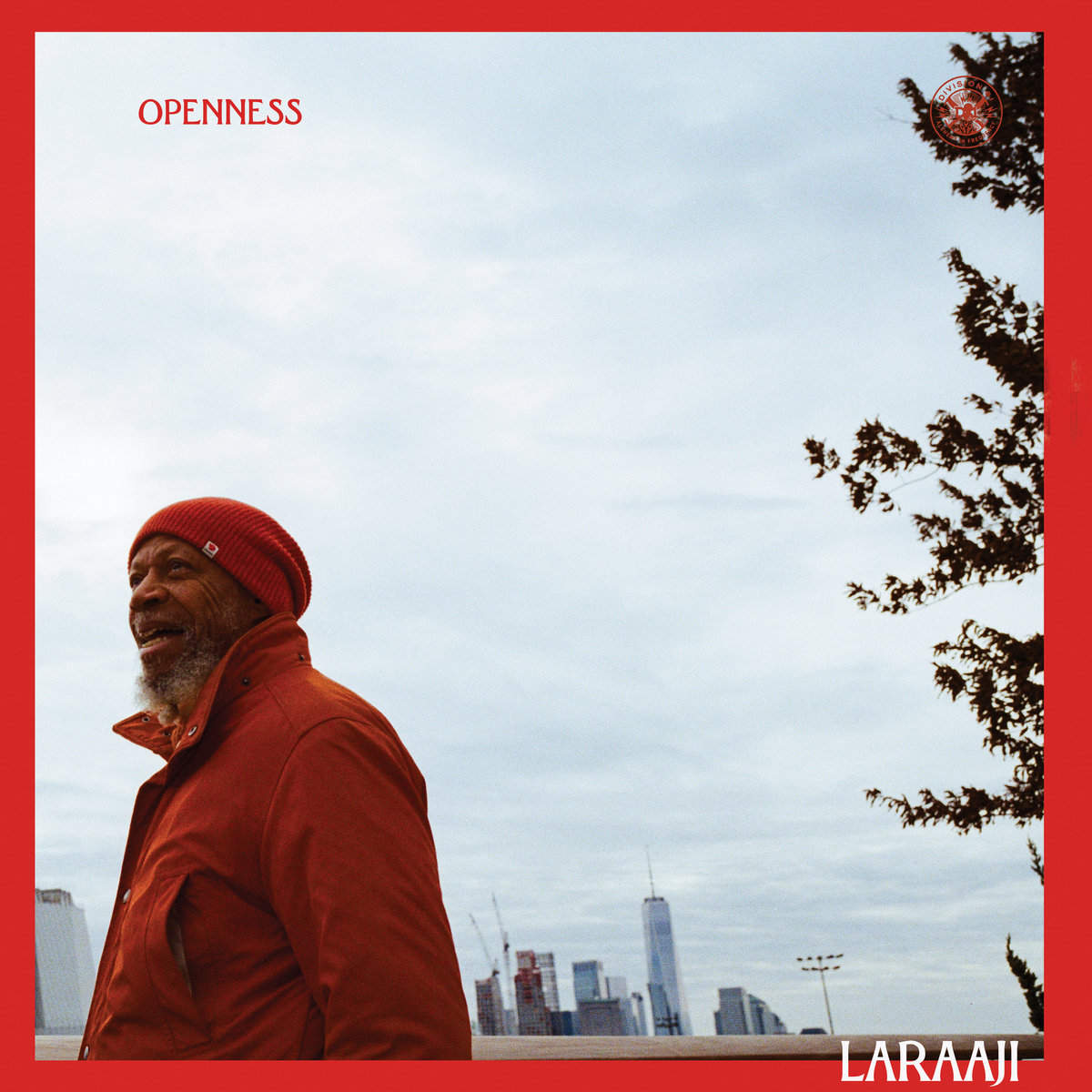
On a balmy spring day in 2025, producer Sonny Daze, saxophonist Isaiah Collier, and ambient music legend Laraaji entered Studio G in Brooklyn, New York, to record what would become Laraaji’s latest musical offering, “Openness”. The aptly titled album blends sacred Sanskrit and African-American spirituals with abundant delay, soaring sax melodies, and improvisational songwriting that reflects Laraaji’s lifetime of musical cultivation. “Being in channeling mode throughout the recording session,” Laraaji reflects, “I sensed the world audience for whom this vital music transmission is intended.”
The virtuosity of Laraaji’s musicianship is often veiled in the meditative ease of his approach. Only when one steps back and considers the depth and devotion required to achieve this “vital music transmission” can one sense the rigor underpinning the freedom. Laraaji calls it celestially guided music, but to be the open recipient of that guidance is where spiritual discipline and musical mastery merge. Through the nonlinear soundscapes and spontaneous songs of “Openness”, Laraaji is guided to unexpected, joyous, and transcendent heights, and, as part of the “world audience for whom this vital music is intended,” we are guided there with him.
This is one of the most song-oriented albums you have released in years. How did you cultivate your capacity for spontaneous songwriting?
I am grateful for having gone to Howard University School of Music and studying music theory and composition. I used to wonder: would I ever catch on to the Western style of classical composition? But in these later years, I found that, being exposed to compositional styles and directions, an intuition kicks in. A composer’s intuition accompanies the spontaneous improvisation process, and what comes out is a near-composed piece of music.
Are you ever surprised at the melodies or the lyrics that arise spontaneously?
More of an elation of sensing that there are inner guides, an inner intelligence that’s operating through me. You can call it the “flow state”. When I listen back, I hear places I would not have gone if I had laboured over pencil and paper and manuscript, trying to compose music. So I’m softly surprised, and I’m elated at the idea that a higher version of myself is flowing through my compositional improvisation.
How do you prepare for a recording session?
That’s always important. Opening yourself as a portal, as a conduit, as a medium, as a channel. That involves letting go of expectations, whether you call it the ego or your limited sense of who you are, letting it soften so that it doesn’t filter out what could be your genius-level transmission. In our flow state, it allows us to be in connection with the cosmic genius that can flow through everyone. And the preparation for that could be doing humbling exercises. One of them is to clean the toilet [laughter] or do some breathing, yoga stretches, do some 5Rhythms dance exercises, or positive self-talk that helps you to step out of what would otherwise be stage fright-producing innerself-talk. I would invite everyone to find their own process. What softens you, what opens you, what lets you dare to be an instrument of a greater transmission that wants to come through you.
The lead single from your new album is “Cosmic Joan,” a reprise of your classic “Cosmic Joe” from “Vision Songs, Vol. 1”. Before we dive into Joan, can you tell us about “Cosmic Joe”?
In the 1980s, one of my standard gigs was yearly being invited to different new-age conferences, usually in the summer months. One of them was at Guilford College in Greensboro, North Carolina. And a couple of those summers, one of the attendees was Joe Tucker, Colonel Joe Tucker. He noticed me, my style of thinking and behavior, and we struck up a spontaneous bond. He would sit and talk with me about metaphysical things. Sometimes it would be a little bit over my head. He’d talk about the chakras and consciousness. He was a proud member of something called, the Great White Brotherhood. I don’t think it referred to race, but rather a higher vibration of intention. We would walk across the Guilford College campus, and he would start talking about metaphysical matters. I was impressed that he thought that I understood [Laughter], but I was getting it on some level.
Before the regular participants would show up on campus, the teachers were called together in the auditorium, and we introduced ourselves to one another by coming up on stage and talking about our intended workshop and what was going on in our lives. When it was time for me to come up and talk, I didn’t feel like talking about what I was doing. So I just got up and channeled this sort of cosmic linguistics, but it allowed the thinking mind to drop out of the linear field and be in space awareness and the present. And as I was channeling this spontaneous release, Joe Tucker in the back of the auditorium broke out in the most hilarious laughter.
Suddenly we had to connect. Something was transmitted. There was this big, lovable bond that just mushroomed into our knowing each other. After that week’s conference, I returned to New York, and a week or so later I got the word that he had made transition. I thought, “Wow, maybe our bond was the icing on the cake that let him know that his student had finally gotten the teaching so he could leave the earth plane or something like that.”
So, spontaneously in a home recording session, I brought through this story of Joe Tucker. “Cosmic Joe” is what I called him, or what he called himself through me. And the song just evolved that way.
In both “Cosmic Joe” and “Cosmic Joan”, there is this beautiful image of each of them becoming one with “Holy Mole.” I’d love to hear what “Holy Mole” means to you.
It’s the Holy Moment, the Holy Momentum. It’s an indescribable place, and the humor of trying to describe it just results in calling it a funny name. We can point to it, we can suggest it, but those who know, know what we’re trying to talk about. So when I say Holy Mole, the Holy Momentum would be vertical space-time momentum and the Holy Moment would be the moment that has no ending or beginning. It’s just the entire field. And sometimes one can feel it by tuning into inner Nadam, the cosmic sound current, which represents the timelessness of the present moment.
In “Cosmic Joe” and “Cosmic Joan,” they are looking for that place so near, which is now. So sweet, because to find oneself immersed in the Holy Moment, suddenly all the density of our physical journey is lightened up and we are in our cosmic light body. So dear, meaning we return to our cosmic self-knowledge where the cosmic heart space is active. Things that we couldn’t love or embrace in our physical personal history body; in this Holy Moment, there’s no issue experiencing the unity of all things. So it’s not a matter of trying to love someone you didn’t love. It’s now awareness that there is no someone other than our very own unified field selfness.
In your spontaneous songwriting, what do you think prompted the re-articulation of Joe to Joan?
It’s because “Cosmic Joe” has been out for quite a while, and in my current work, lectures, workshops, and residencies, they’re attended more by female energy, women. And I realise that some of them are mothers, and I find that mothers have a difficult time of making time for meditation or things of a higher vibrational nature because part of their attention is focused on caretaking. And so I feel that what is needed is a better mousetrap for women who are sincerely interested in pursuing their inner development. And so my heart reaches out to all the women, girls, female energy that find that their roles in life hamper their inner spiritual discipline. I’m trying to remind them that what you’re seeking is right where you are.
“Cosmic Joan” is subtitled “For Lebertha.” Who is Lebertha?
That is the name that Sonny Daze used, though I haven’t met his Grand Aunt Lebertha; he probably felt this song should be dedicated to her for his understanding of her life, practice, struggles, or what she was reaching for in her personal life. The song, as it came through for this particular recording, is dedicated to each and every female being, primarily those who felt they were second-class citizens in the cosmos.
On Openness, your interpolations of the spirituals “Nobody Knows The Trouble I’ve Seen” and “Wade In The Water” are profoundly affecting. And I was wondering if you had any thoughts about why those particular spirituals emerged spontaneously during the recording process.
The Baptist church upbringing exposed me to spirituals. Also, having attended Howard University, I was exposed to Negro spirituals. In my metaphysical transcendental self-work, I would consider that some of those spirituals were very enchanting and warming, but the lyrics kind of limited the sense of what we have access to. The original lyric is “no one knows the trouble I’ve seen, but Jesus.” In my current years, I’m realising that the oneness is the place where I go and dissolve. When I dissolve, I realise that the troubles I’ve seen aren’t really my troubles. They belong to the human sense of self. And so when I dive back up into this unity, this oneness, the oneness in me looks at the troubles, and they dissolve. They don’t stay with me. They’re not heavy anymore. The troubles I’ve seen become light, become spacious, or become stepping stones to inner self-understanding.
“No one knows the beauty I’ve seen.” I’ve switched from the troubles of the world in the earlier version of the spirituals to positive affirmation. So, “no one knows the bliss I’ve seen, but the oneness.” This means pulling the whole story out of the past and future, out of personal history, and dwelling in continuous present time and the field of infinite perfection. It transforms the song from a song of human sorrows into a song of triumphant self-recognition. “No one knows the beauty I’ve seen except the oneness.” The human spirit may know happiness, but bliss belongs within our original cosmic identity, so this oneness is the only one that understands bliss.
It comes as this beautiful liberatory moment at the end of the album when you invoke “Wade In The Water”. Does this spiritual have any particular significance for you?
All of the spirituals seem to be putting into words that which doesn’t really fit in the container of linear language. So, “Wade In The Water” for me means to be mindful as a conduit of the infinite spirit. To wade in the water, to me, means simply being still or being mindfully active as a conduit of this infinite glorious wonder.
It was exciting to hear you on Fender Rhodes for this album. The instrument you played in the 70s with the jazz-rock group The Winds of Change.
Yes. I believe it is the first time that I’ve recorded on it in a long time. Fender Rhodes has not been that accessible to me outside of the studio. I don’t get to play it that often. I love the sound. Its inner mechanism uses tines, rather than strings. It was originally used by the military as a healing instrument.
I love the Fender Rhodes. As a matter of fact, playing with Winds Of Change involved my lifting this keyboard and the cabinet amplifier onto the van, off the van, into the venue, out of the venue, back onto the van. And I thought, wow, the labour of love [laughter].
How did you connect with Isaiah Collier for this album?
At New York‘s Jazz Festival, Arji OceAnanda, and I think one other person and myself offered a performance set, and after we finished, there was a changing over of the stage, and the rush of the next performing group involved Isaiah Collier. We just made eye contact, a big smile, and he announced that he was open to somehow working together in the future. That was our first connection, and we have not really had an opportunity to work together until Sonny Daze brought us together.
Isaiah Collier is an eminent saxophonist, but he plays drums more than sax on this record. How was playing with live drums? I feel like that’s pretty rare for you in your solo work.
Yes, it is. But the chemical impact of that drove me. My earlier work with jamming was in Aquarius Coffee House in Brooklyn, New York, and various other late-night jam sessions and recording studios in Brooklyn. The idea of musicians coming together and informally bringing forth sound and jamming along- the spirit of that was rekindled when Isaiah was on the drums. I was not aware of what he was going to be doing in the session. So the drumming was rather flowing, informal, and exploratory. And it reminded me of the spirit of those jams in the studio in Brooklyn in the late ’70s. Musicians would chip in $15 or whatever to rent a studio in its off hours from 12 to 4 in the morning, and we’d pile in and just rock out. So that spirit of having a musician over in the other part of the room playing the drums just lent itself to the experience of being in that warm, friendly, exploratory, improvisational situation.
As with “Vision Songs, Vol. 1”, and the Casio MT-70 drum machine, I wonder if the drums on “Openness” helped inspire the spontaneous songwriting.
Yes. Because dance is a large part of my recreational leisure meditation practice. Drums that support a feeling of dance movement help to support the improvisation of lyrics and set an environment within which music has movement, joy, and celebration.
Is there an intention you’d like to send out with this album as it enters the world?
The music we release is to support someone’s feeling of bliss, to commit to their inner journey in a new, fresh way, to shift their mindset around certain conditionings, and to trust the opening onto the new frontier of their beautiful life unfolding.
Beautiful. Thank you.
“Openness” was released on September 11, 2026, by Division 81 Records.
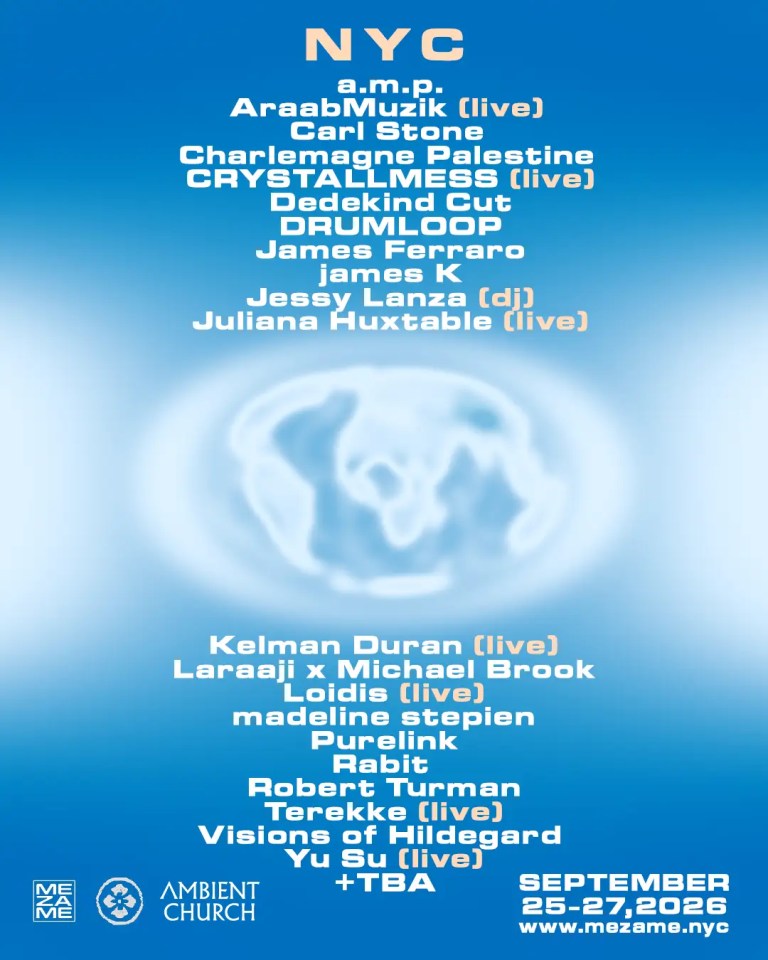
Laraaji will be performing at the inaugural Mezame Festival on September 26th with composer and guitarist Michael Brook. It will be their first time performing together since Brian Eno’s legendary Opal Evenings series.
Discover more from Ban Ban Ton Ton
Subscribe to get the latest posts sent to your email.

