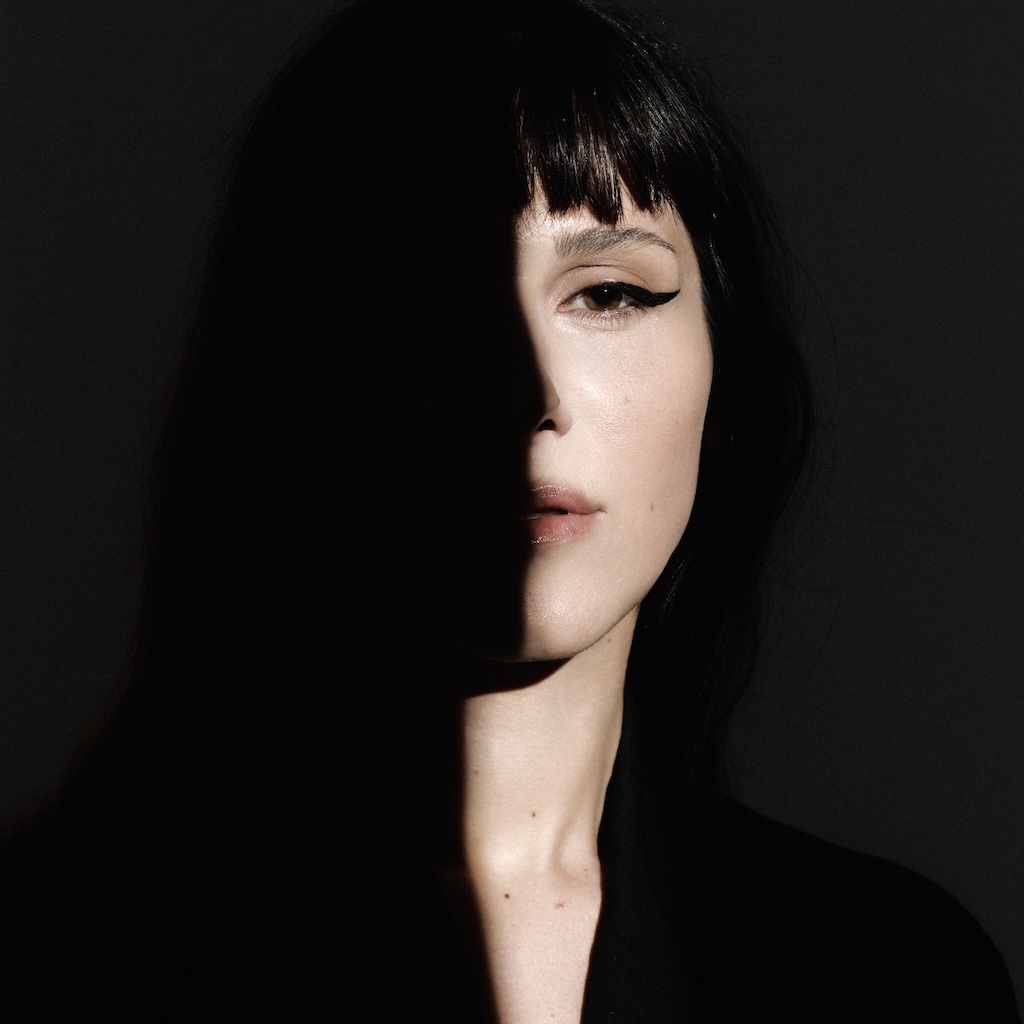
Fantastic Twins is creative alias of French artist, Julienne Dessagne. Her debut release, “Obakodomo”, picked up by Optimo back in 2017, was the score for a contemporary dance piece. Since then Dessange has cut sides for the respected imprints Kompakt and Hippie Dance. Subsequently launching her own label, House Of Slessor, in 2025. In the past, she’s been a live guest of Andrew Weatherall at his Convenanza festival, and collaborated with folks such as Cosmo Vitelli, JD Twitch, Superpitcher, Red Axes and Khidja. Most recently, Dessange reworked a commission performed at the Beta Biennial Of Architecture in Romania for Emotional Response. A radical reimagining of Chris Isaak’s “Wicked Game”, it caught the ears of everyone at Ban Ban Ton Ton. John Matthews penned an inspired review, and I had the pleasure of posing Julienne a few questions.
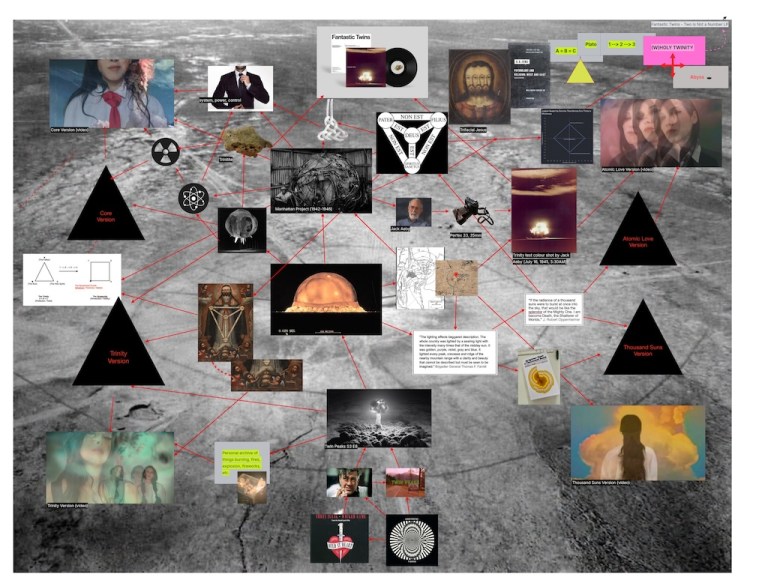
Julienne Dessagne’s “map” of Fantastic Twins’ “Wicked Game (Trinity Version)”, hinting at some of the mystery and magic held within.
What was it that prompted you to cover “Wicked Game”?
It was prompted by an invitation to perform live at the Beta Biennial of Architecture in Timișoara in September 2024. The theme was “Cover Me Softly” and I was asked to choose a song to cover as part of the performance. I considered many options, but “Wicked Game” was my first idea, and I kept circling back to it, so I trusted that intuition. The song connects me instantly with David Lynch, but it also unlocks some personal memories. And on a purely technical level, my voice sits in a similar register to Chris Isaak’s, so there was a natural correspondence.
The manipulation of vocals seems key to the concepts behind “Fantastic Twins”. In the past, you’ve talked about avoiding lyrics – not imposing a narrative on listeners – and focusing on sounds. What made you change your mind here?
“Wicked Game” is primarily a song about love, but there are so many other possible meanings and layers of interpretation beneath the romantic surface. I wanted to explore those spaces between the lines and take the song into less obvious territories. And in that sense, it totally aligns with my interest in ambiguity, and with my preference for lyrics that leave room for the listener’s imagination. It also didn’t conflict with my focus on sound, as the vocal processing on these reinterpretations was quite complex and deeply rooted in electronic music techniques.
The song features in the David Lynch film “Wild At Heart”. The title of your debut album “Two Is Not A Number” was inspired by the Lynch short “What Did Jack Do?” Would you say that Lynch is a big influence on your work? If so what is it about his art that speaks to you?
He’s definitely one of my biggest influences. I don’t really know what it is about his work that speaks to me so deeply and I don’t think I want to analyse it, because that’s precisely what makes it so powerful. The strong imagery, the things that operate on a subconscious or subliminal level, everything that exists beyond what language can explain, that’s what resonates with me.
Do film and visuals in general play a big part in inspiring / influencing the music you make?
Very much so, and increasingly so. Images, film, videos, paintings, anything visual really, help me write music and unblock me whenever I feel stuck. I archive a lot of material, it doesn’t have to be established art, it can be anything I encounter in real life or online. When I’m working on a project, I tend to connect it intuitively to these collected visual memories. These associations aren’t necessarily planned as part of a concept, unless I’m working on a soundtrack where visuals are there from the start. For me, it makes the process move between randomness and control, and I enjoy that element of serendipity because it can uncover something in the music that I hadn’t seen before.
Do you have any other favourite film directors and visual artists?
I can’t say i’m a huge cinema connoisseur, though I wish I could dedicate one of my next lives to it. I love David Cronenberg, Werner Herzog, both explored twins’ minds, as it turns out. Agnès Varda, Claude Chabrol, Ridley Scott. I love proto-Renaissance and late Gothic art, the photography of Ludwig Windstosser, Pierre Soulages, Mark Leckey, Cyprien Gaillard, Nina Hartmann, etc. And all sorts of strange things I find on Youtube.
I know that you’ve worked scoring contemporary dance, have you had the chance to move into theatre or film?
I’ve written music for documentaries, short films, art installations and had my music featured in series, commercials and fashion shows. But I’ve never composed for theatre, I’d love to. I find composing for other art forms almost more inspiring. It might seem contradictory since you’re working within the constraints of a given project, but I find those limitations very stimulating.
You were a big gamer. Do you still get the time to play. If so, what’s your current go to? My kids have hit “League Of Legends” and for years now have been stuck / hooked. Has any of your music been used in games?
Not a big gamer anymore sadly, I don’t have the time these days and probably for the best, as I get addicted very quickly. I tried to get my son hooked on “Animal Crossing” (laughs), so I’d have an excuse to play, but it didn’t last long. “Clair Obscur” and “Death Stranding 2” are on my list though. I never had my music featured in a video game, but I’d love to soundtrack one.
In our review of the EP we likened some of your vocal treatments to Lynch’s “red room” speak. Were we imagining this? Were we wide of the mark?
It wasn’t intentional, but I do love manipulating vocals. That’s the main common thread through all the music I’ve released so far. I find the human voice endlessly inspiring to work with. It’s so malleable and you never get the same result. It can be fragile, sensual, strange, unsettling, eerie, haunting, or all of those things at once. And yes, I do have a soft spot for reversed vocals, because they take the pressure off the meaning of the lyrics, and because harmonically, you often get interesting outcomes.
At what point, and why, did Lynch’s recreation of The Trinity Test come to be linked to your reading of “Wicked Game”?
It happened while I was working on the first version, hence the name “Trinity Version”. I was about to record the second half of the instrumental, where the distorted guitar-like synth part comes in. I wanted to do it in a single take rather than edit multiple takes afterwards. I find that recording in one take allows the music to breathe more naturally, whereas editing can make the process much more controlled and cerebral. That part was completely improvised, so I felt I needed a strong visual stimulus to help me find the right flow. That’s when I thought of connecting Lynch’s recreation of the Trinity test from “Twin Peaks” S3 E8. I just pictured a lot of smoke, something massive and annihilating and that was the first image that came to me. It was pure serendipity really, and fascinating to see how that intuition ended up mapping out all four versions, as well as the entire visual identity of the project, from the artwork to the videos I created for each version.
Is there a social / political sub-text to your reframing of the song? The “wicked games” not so much an untrustworthy lover, as greedy, uncaring, sociopathic governments? Climatic crises, conflict?
I’d say my approach starts more from a philosophical standpoint. My reinterpretations question our relationship to technology and science, and how we choose to use knowledge. From there, it ultimately leads to what political and military power makes out of technological innovation and scientific progress, and how their trajectories can be diverted away from the common good. The Trinity nuclear test is a powerful symbol of that ambiguity, that liminal space between what the human mind, constantly pushing the boundaries of science and technology, is capable of, and the possibility of self-annihilation.
Can you please tell me more about the Beta Biennial of Architecture where the piece was first performed?
The event brought together exhibitions, installations, talks, workshops and live performances that took place in September 2024 at The Garrison Command. Tina Cucu, ex-RBMA team member, curated the music programme and invited me to perform. As I mentioned, the theme was “Cover Me Softly”, the concept of borrowing the cover song as a model “for exploring cycles of knowledge and authorship in contemporary creative production”. I wasn’t able to see every installation, but I managed to catch a few minutes of Cynthia Fleury’s inspiring talk about the ethics of care before my soundcheck. All the works presented reflected on what it means to build something new from pre-existing work, the ethical questions raised by the act of reinterpretation, how we define what belongs to us, and to what extent this can be a way of creating continuity and connections across different art forms. For me, it really put the exercise into perspective and I couldn’t have wished for a better environment in which to give birth to this project.
Was there a “remit” for the performance piece?
No, I had complete freedom to choose the song I wanted to cover. It’s stylistically quite different from my live set which is more club-oriented, so I performed the song as the final track of my set. It was a beautiful moment.
Your production on the piece, to my ears at least, seems to pay tribute to This Mortal Coil’s cover of “Song To The Siren”. Was this conscious, or, again, am I imagining the connection? I’m sure you know that the This Mortal Coil song was one of Lynch’s favourites.
I can’t say I deliberately set out to pay tribute to anyone in my music. As much as I absolutely adore This Mortal Coil’s “Song To The Siren” and it’s one of my favourite songs ever, it would be too daunting and creatively paralysing to have it in mind while working on my own music. It’s different when drawing inspiration from another medium, like visuals. With music, there’s always a risk of ending up mimicking someone else’s work. And by saying that, I don’t mean to minimise the role of influences, because of course they’re always intertwined somehow. But when you’re creating something, you have to leave room for what’s in you that hasn’t been discovered yet. In this particular case, I had nothing else in mind but Chris Isaak’s song, what it evokes in me and how that relationship could translate into my own versions. In the beginning at least, there were no other guests at the table – except for Lynch. Though loads of others showed up uninvited throughout the process!
Vocally I can also hear other 4AD things like Dead Can Dance and Le Mystère Des Voix Bulgares in your work. Again, am I just stretching for references?
No, and I’m flattered you hear parallels with Le Mystère des Voix Bulgares because I do love that record very much. I’m always somehow surprised when I read these comparisons because outside references don’t play a conscious or intentional role in my music. The way I approach music production isn’t so much about “what or who do I want my track sound like?” but rather “what should it feel like?”. A crowd chant on the street or in a stadium, or the sound of a broken elevator, or a piece of dialogue from a film, is more likely to send me to the studio than thinking “I’d like to make a record that sounds like this artist, or that song”. But in the grand scheme of things, we’re all fishing in the same big ocean, aren’t we?
Could you please tell me more about the equipment and effects that you used?
For hardware, I used the UDO Super 6, a polyphonic, binaural analog-hybrid synthesiser that I used extensively on Suite of Rooms too. I used a Prophet 6 and the Waldorf Iridium as well. I processed most of the layers, including the vocals, through my Eventide H3500, and used the Nightsky reverb pedal from Strymon for the more generic reverb. I spent hours processing and reprocessing different elements, experimenting with various parameters and spatial characteristics until I found the sound I was looking for. I must have used my modular system as well for additional effects and filters. When I recorded the three additional versions, I had also just got my hands on the Evil Pet from Endorphines, a granular processor that I love and used a lot on this record. I programmed the drums for the “Thousand Suns” version on an Elektron Machinedrum. And some of the pad layers were built from a Spitfire sample library, alongside a couple of VST synths.
There’s a great, kind of feedback solo running through “The Trinity Version”. I’m not a musician, so please excuse me, was this an E-bowed guitar – if so, is it you playing – or is it more vocal processing?
I improvised this part in one take, played via MIDI, and then re-recorded it through different sources, so it’s actually made up of several layers of sound. I think I first used a VST synth, then recorded the same part again through the Super 6 and ran it through amps and distortion. I then sent the whole thing through the H3500, live-dub mixing style. And I think I also reversed some sections of the fx layers to create some ghost-like variations and add depth.
Was there anything unique about how the piece’s textures were created? I have read that you have a fascination for new kit.
Nothing other than going into meticulous detail. I spent a lot of time sound-designing each layer and making sure that everything that was in the mix had a reason to be there. I wanted the finished piece to sound warm and spacious, with everything blending together seamlessly. It had to sound as if it were disintegrating in a big cloud of smoke. The textures come from all the processing, and the way I placed each element in the stereo field also has an impact on how they’re perceived. I do love trying out new machines, while staying conscious of putting the technology at the service of the idea, rather than the other way around.
I have also read that the Eventide H3500 is your favourite. Was that used here?
Yes, always. I use it on every single piece of music I make. To me, it’s much more than a multi-effect processor, I don’t just use it to polish sounds, I really integrate it as a creative tool. On the “Trinity Version” and “Core Version”, for example, I used it to create the sort of gothic choir for the “no I don’t wanna fall in love” refrain. Rather than sustaining the note with my voice, I wanted to make it sound like a church choir and turn it into a tragic mantra. I recorded the vocal through a reverb, then processed the fx vocal through another reverb programmed differently, and repeated this until I got the sound I wanted.
I’ve seen you mention that Ai can me a useful tool, opening up creativity. Could you please explain how?
Technology always comes down to what you do with it, that’s the wicked game! I was referring to artists like Laurie Anderson and Holly Herndon, for instance, who have trained and integrated AI in their practice in interesting, creative ways, using it as a collaborator rather than as a basic production tool.
That is obviously very different from AI slop, and the kind of AI-generated music that invaded the internet and impacts the whole economy so negatively. But I think it’d be sterile for artists to exit the debate entirely because of that. For electronic music musicians, technology is an integral part of our cosmos. Nowadays, many new music-making tools and technologies are designed to generate material automatically, algorithmically, so AI is essentially an extension of that same logic. You’ll always have lazy people whose goal is purely lucrative and who are happy to let the technology do the job for them. As artists though, our power resides in our ability to adapt, to react, to subvert conventional uses, to misuse, to repurpose. Technology only becomes interesting if you establish a dialogue with it. I personally haven’t found an interesting way to integrate AI in my work so far, and I usually tend to walk away from tools that “do too much” as I feel they inhibit my creativity. With AI, if you don’t put the effort in, all it does is regurgitate things that already exist, often very polished, unsurprising sounds. But if I dedicated more time to it, I have no doubt it could open new portals.
Could you please tell me more about the remixers, your relationships with Optimo and Aho Ssan?
I’ve known Jonnie (Optimo) for 20+ years, we met when I used to live in Glasgow. I was a regular at their Sunday residency at Subclub, and it’s fair to say those nights have shaped my ears. I then released a lot of my music on Optimo Music, JD Twitch’s label, so there was always a familiar bond between us. I’ve always liked Jonnie’s work as Naum Gabo – his project with James Savage, so I was really pleased when he asked to remix the “Thousand Suns” version, especially as I remember him playing Isaak’s “Wicked Game” regularly at Espacio. Having him be part of this project feels like a full-circle kinda thing.
As for Aho Ssan, I loved his “Rhizomes” album from 2023, and I knew he had the talent to push what I had started with my versions even further, and turn the old romantic lover classic into something much more contemporary. It made perfect sense that he chose the “Core Version” to remix, because to my ears, the result sounds as if you’re completely trapped inside the radioactive core, with the echoes of the vocals creating this unsettling feeling of a love story gone too far, disintegrating into dust. We were introduced by our mutual friend Guillaume Sorge – who runs Les Yeux Fermés amongst other things. Désiré felt very inspired by the project, and it was a joy to work with him throughout.
Another quote from you is “I’ve never made happy music”, and you have been critical new age / wellness industries, the media narrative of “happiness” as a goal. Could you please explain this further?
Yes, I can’t say I make happy, uplifting music and I’m totally fine with that. It doesn’t mean I can’t make people happy with my music. Happiness is a lifelong personal and spiritual quest, and exploring our dark corners is entirely part of it. I’m not here to force emotions, if anything, I just hope my music can make people feel something.
Questioning the wellness industry and toxic positivity was the main focus of a short label series called “Microdosing”, which I curated a few a years ago in collaboration with French visual artist Geff Pellet. Ivan Smagghe wrote the manifesto at the time. It was essentially a collective reflection on the tyranny of the self, the capitalist injunction to positivity in all its corporate undertones, hyper-individualism dressed in yoga pants, and so on. At the time I ran the series, there was a plague of positivity memes, and their omnipresence made these messages seem even more bland, especially in contrast with the brutality of the real world. I felt it was an interesting phenomenon to explore, both aesthetically and sonically. Cringe material is good material.
Personally, I think the pursuit instead should be understanding. A lot of people have a lot to be genuinely pissed off and depressed about. The story that we are being sold is that it’s our fault, the problem is with us. That we should try to solve this from within, via medication or self-improvement, when really it’s the consequences of very real external forces – unemployment, displacement, homelessness, the absence of a secure future.
Yes, I agree. And once you deny collective responsibility, and reduce people’s problems to an individual level, it becomes much easier to assert power over them.
Can you please tell me what you have lined up? Releases and / or live performances.
I’m planning to continue working on a project I started a few months ago that could eventually turn into a new album. I have this swan’s death syndrome every time I release something, so right now I’m mainly reviewing and processing new ideas, adding fuel to the tank so to speak, until I feel ready to dive in properly. Lately, I’ve started experimenting with video, and I want to explore this medium further and see how I can create a dialogue between it and the music. I have some live shows lined up too, in Montreal, Paris, at an art biennial in Dakar…
When can we expect something new from House Of Slessor or your next dance floor numbers for Kompakt?
There will be more releases on House of Slessor, hopefully next year. I also have some unreleased material that I created from my live set, more dancefloor oriented, that I’d like to put out. I do have a bit of a split between the quieter, weirder side of my work, and the more upbeat, in-your-face techno side. I’d love to find a way to combine those two sides better, or perhaps differently. That’s where my thinking is at right now.
Do you have any exciting collaborations coming up?
I got several requests for vocals featuring following the release of “Wicked Game”, but I prefer to keep those to a minimum. I contributed vocals for Sascha Funke’s new album, coming out in November on Kompakt. I’m also about to write vocals for a track with Cosmo Vitelli, whom I’ve collaborated with in the past. And a few months ago, I worked with Elisa Visca, a visual artist based in Berlin, and I’d like to continue working with her on new projects in the near future.
Have you ever been introduced to the Vanishing Twin?
Not yet, but the twin frequency may bring our paths to cross one day. Who knows?
Fantastic Twins’ “Wicked Game” is out now. Digital can be purchased from various platforms. Vinyl can be ordered from Emotional Response, or Julienne direct.
You can learn more about the history and future of the Fantastic Twins project over at Julienne’s dedicated website and Instagram.

Discover more from Ban Ban Ton Ton
Subscribe to get the latest posts sent to your email.

