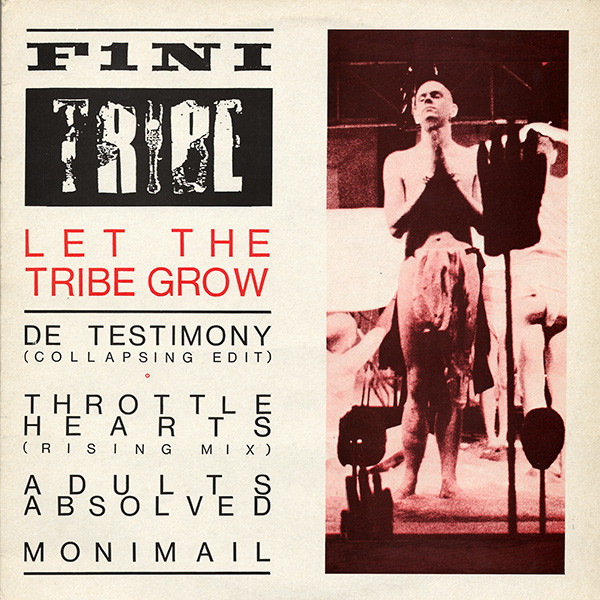
Edinburgh band, Fini Tribe, are about to release a big retrospective. Titled “The Sheer Action of the Fini Tribe” the collection focuses on the outfit’s early years – compiling studio cuts, and excitingly, rare live recordings.
The album has given me the chance to speak to founding member, Chris Connelly, who since the late `80s has been based in Chicago – working with, amongst others, the city’s legendary Wax Trax operation.
Below is part one of our conversation, where Chris concentrates on the creation of Fini Tribe’s “Balearic Beat” classic, “De Testimony”.

Chris Connelly captured by bandmate Andy McGregor, circa 86 / 87
Words from Chris Connelly in conversation.
The gap between our first single, “Curling & Stretching” and “De Testimony”, was about 12 to18 months. The two are radically different. We changed at a fair clip. Although for us, it felt slow and organic.
We were always a band who craved change, sometimes to our detriment. We would play a set of songs, for one, maybe two gigs, and then we’d be like “okay, we’ve done that, let’s write 10 new ones.” The other the most important thing was that we got a sampling keyboard. John Vick, our keyboard player, and, effectively our engineer, had built this echo unit, which we could use to sort of sample, but then we bought an Ensonique Mirage, which was one of the first affordable sampling keyboards.
Bands like Test Department were a big influence on us as well. I remember us all going to see Test Department play at an abandoned bus depot in Leith, and there was no stage as such, the audience were just standing around the band. For instruments they had these huge skips and old oxygen tanks, and things like that, I mean, how radical is that? We were used to seeing bands like Prefab Sprout, and then all of a sudden, this. No lighting, just this white sodium glare, and these guys with hammers instead of guitars.
We were living in an environment where we had access to lots of scrap metal. I just had to walk around the streets to find things. We brought this stuff back to the practice room and made sounds from them. You remember how in punk you were told you all you need is a guitar and three chords. Then Throbbing Gristle said, well, you don’t even need guitars, you don’t even need the chords.. and then Test Department sort of said, well, you don’t really need electricity. We didn’t go 100% that way, but I do remember me and our drummer Simon (McGlynn), finding an abandoned car and just battering the fuck out of it. It was visceral, it was fun to do, and we’re all 19, 20 at the time. We had a lot of energy. We modified some of this stuff and would bring it on stage with us. Not the car, though. That was just one afternoon on the dole. We had an old building alarm bell that we used that had a great resonance.
We also loved 23 Skidoo. “Seven Songs” was a huge one for us. You know, that marriage of noise and dance that we’d been craving. It wasn’t like we were looking for them, we but it was really nice to have peers. We just wanted to know that we weren’t the only people on the planet who were doing this kind of thing. A Certain Ratio were very big for us as well. 23 Skidoo though were a bit more out there. They were more post-Throbbing Gristle. 23 Skidoo carried that for me. The creepy samples of people talking about porn and stuff like that, and the weird sounds that you couldn’t identify, but the drumming was just so… it was fire, man. It was so good.
Where we rehearsed was in the famous Niddry / Blair Street area of Edinburgh. The space that we used was an abandoned tenement, and if you kept going up the stairs you got to the storage room of a department store. There we found all these clothing racks, so we stole a bunch. If you overturned them, and hit them, it had a sort of bell effect. So we had these things, and Davie (Miller)’s little brother, Angus, was a welder. He could weld stuff for us. We actually used to bring him on stage with us, and he’d weld live.
Wilf’s Planet is where we always recorded. We recorded our first demos there in 1982. John worked there, and Wilf was a friend of ours. It was a tiny little pokey place on Broughton Street in Edinburgh, in the basement. The engineer who worked there with us, Chic Medley, he was in the band Fiction Factory, and they’d just got this big, huge, big Emulator, which, you know, was like, the holy grail for musicians at the time.
When we first got the sampler, we used to spend a lot of time in smaller groups, getting together with John, just 2 or 3 of us, in a bedroom to try and come up with sounds, and Philip (Pinksy)’s flatmate, Lindsey, had this 5-inch reel with about a centimetre of tape on it, and he said, “Why don’t you see what’s on this?” We put it on, and it was church bells peeling. So we sampled it, and played this melody straight off the top, and that’s how the bells happened. The percussion on “De Testimony”, though, was all live. That’s what gives it the energy.
The lyrics were all nihilism. There’s a concept for you. It was informed by this incredible misanthropy and nihilism that I tried to turn into some kind of poetry:
“With the bells serpents are “something” where violence grows, even collapsing uncertainty grows, heaven and sea sticking to me. Over the sight of your city in flames, cleansing and purging the sick from the same. saying you should have known that the fire was divine, proving your life the most holy of times…”
Or something like that. I always have this deep religious imagery in my songs, because I was brought up so super Catholic. I was in a choir and everything, and I loved the imagery. The name Fini Tribe actually comes from Rosicrucian monks. They decided that “fish” was too demeaning a name for fish, and so they called fish “The Fini Tribe”.
“De Testimony” was a section of a larger piece, something about 15 minutes long. We’d been loaned one of these really sweet Niagara reel-to-reel tape recorders and walking around the streets of Edinburgh recording ambient sounds, we got this great road drill, which John sampled and turned into a rhythm. This ended up being the jumping-off point for the piece.
(Chris imitates the sound of the drill and the transcription Ai throws up its hands and surrenders.)
It was Robert King, from Cathexis Recordings, in Glasgow, who singled the “De Testimony” section out. Robert was doing cassette releases and we’d made him a track for a compilation called “You Bet We’ve Got Something Against You”… which was, us, Current 93, Sonic Youth, the Dave Howard Singers. That’s how we got to know him, and then he wanted to do an EP.
The photograph on the sleeve of the 12” is a picture of me, from a pretty notorious performance of the piece that we did. It might look like some kind of ritual but it wasn’t. We weren’t into any kind of cult-y / occult-y thing. I loved Psychic TV, but I drew a line at the Temple Ov Psychic Youth. That wasn’t of any interest to me. It was sus. You know, they would ask you to do these strange sex sigil things and send them to them, and I was like, no, no, no. I was not into that, but I was friends with Genesis (Breyer P-Orridge) for a very long time.
Fini Tribe had got to the point where we were tired of performing as, for want of a better word, a rock band. We weren’t technically great musicians, but we worked really hard, we practiced a lot, and we tried to come up with stuff that no one else was doing. We were trying to push our performance in the direction of using films and things like that to make them more interesting. We were all, to varying degrees, visual artists.
This is led what led to “that” gig. It was called “Absolution”, and it took place at the Assembly Rooms in Edinburgh, which is a really nice building. We made these plaster of Paris hands, and put them on sticks. We had a lot of sheeting and lighting, and we had choreographed it musically and physically.
At the end of the performance, we had these giant bin bags full of poster paint which we punctured, and the pressure from the spilling liquid made them revolve, covering the whole audience in paint. We got into all sorts of trouble, but we didn’t really give a shit. It was water-based, so they could wash it off.
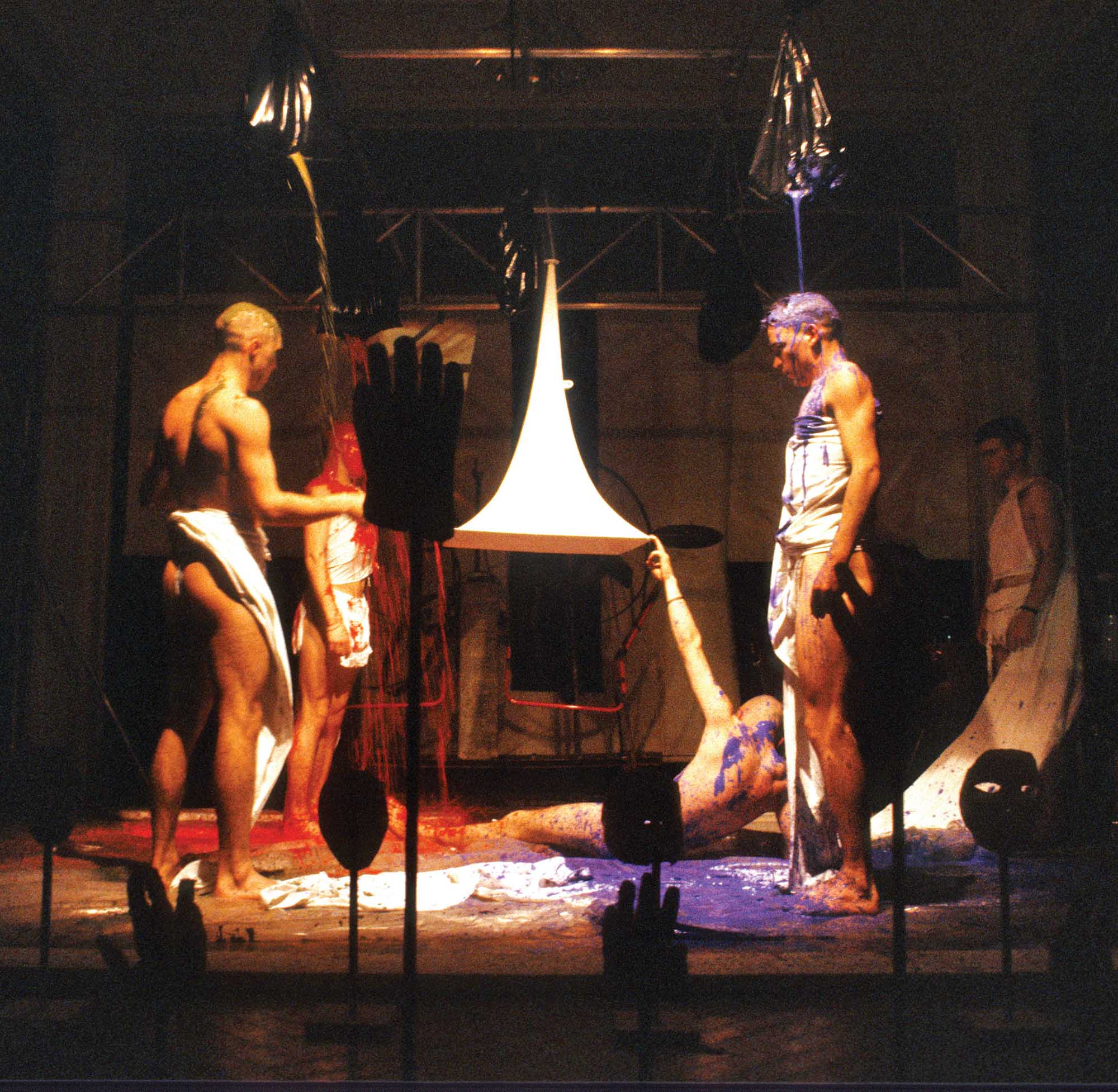
Absolution performance.
By the time Fini Tribe split, in 87, “De Testimony” hadn’t really gotten any attention. It had been used to soundtrack a Glasgow fashion show on The Tube, but that was about it.
We were approached about licensing it to the “Balearic Beats” compilation, at least a year later, and no one was more surprised than us that all the Spanish DJs in Ibiza had picked it up. Giving it a new lease of life. Rave didn’t exist when “De Testimony” was released. I’d already moved to Chicago and was touring with The Revolting Cocks, but I was really happy about it. To the other guys I was like, “Well, go and have fun”, you know? I was on another ride by then.
“The Sheer Action of the Fini Tribe 1982-1987” can be ordered directly from Chris Connelly’s Shipwrecked Industries / Finiflex Records.

Discover more from Ban Ban Ton Ton
Subscribe to get the latest posts sent to your email.
 Ban Ban Ton Ton
Lots in here I never knew.
Love the aside about the transcribing AI tool too.
LikeLike
Peel played De Testimony 4/5 times end of 86/early 87. Still have it on cassette from one play. He said at the time that quite a few people wrote in asking him to play the song with the bells. Maybe with more marketing could have gone in the charts. I guess without Ibiza it would have been remembered fondly as a very good but niche Indie record.
LikeLike