Pukka prose by Patrick Syms.
When I was three my family moved to Ramsgate. More specifically, to a farmhouse that overlooked Pegwell Bay. The end of our garden was steps away from the cliff edge. It would have been hard to live closer to the coast.
At Little Cliffsend Farm there was no electricity, no mains sewers and no bathroom. No fridge, either. None of this was due to neglect or malfunction. It was how it was advertised. The only concession to 1970’s modernity was a tall gas cylinder sentried outside the front door. Indoors was a bubble of an earlier time, when expectations were lower, comfort was defined by different amenities and postwar economic development was speculative fiction because what war?
Though there was no bathroom at the farmhouse, there was a loo and – mercifully – it was indoors. There was a bath, although it was in the kitchen, covered by a removable board that converted it to a work top. Lighting and heating were powered by the gas cylinder. Sewage was collected in a septic tank which was emptied every fortnight by what we referred to as the pong wagon. On a farm in 1921, this arrangement might have felt luxurious. But this was 1971 on the outskirts of a fairly large town not far from London.
In this recreation of past times, my father would wake every morning and time travel to the future. At the bottom of the cliff on which perched the farmhouse, 500 metres away as the seagull flies, lay a gleaming Helvetica-ed building atop an expanse of concrete which served as the launch and landing pad of two huge mechanical marvels: the new cross-Channel hovercraft. My dad had no time machine. Instead, he climbed into a dirty green Hillman Imp and drove up the dirt track that led to the farm. At the top he took the first of three left turns and in as many minutes arrived at work. For almost the entirety of my childhood and adolescence he worked on the hovercraft. First in Ramsgate and later, when the two services became one, 20 miles down the coast in Dover.
A coastline is a strange connector, uniting places on a physical line in a way that similarly close landlocked towns can never share. Ramsgate, Dover, Folkestone. For me these were places of arrival but also departure. Towns of transit, exchange and exploration. The idea of the hovercraft representing the future may have dulled by the mid 80s, but my sense that the coast was a place of openness, progress and possibility remained.
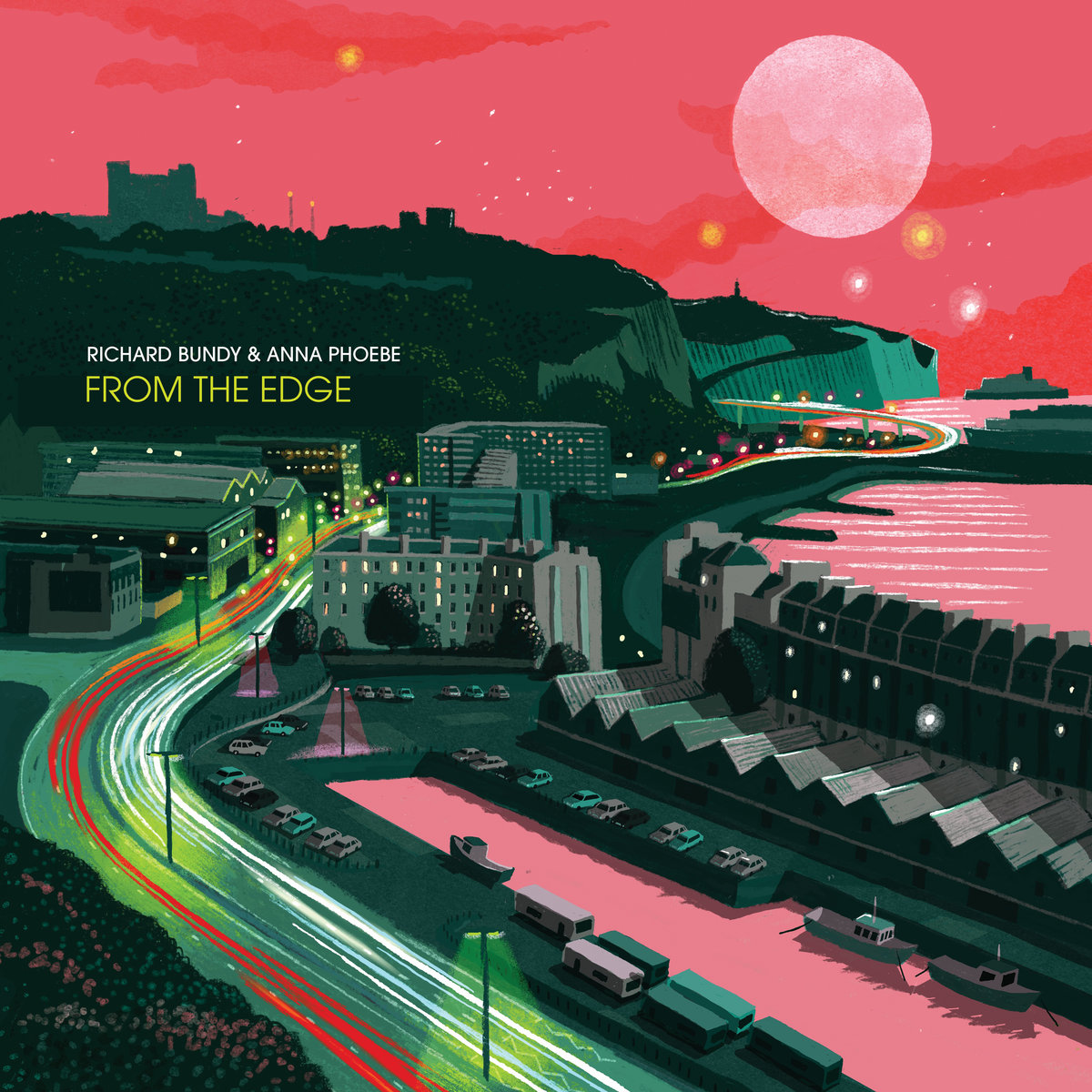
A three year long project led by musicians and composers Richard Bundy and Anna Phoebe, “Dover Unlocked” is “a body of work that reimagines and quietly subverts the accepted narrative of this UK coastal border town” through music performed and recorded in historic locations in and around Dover. With contributions from a long list of collaborators including The Sacconi Quartet, it finds form in “From the Edge”, released through Clay Pipe Music. Comprising two “whole-siders” the work is a mix of organic and electronic instrumentation, choral elements and field recordings from the surrounding area, including traffic on the A20. It blends modern classical and ambient elements with moments of neck-snapping groove. The two longer pieces comprise shorter passages that change in pace and temper in a way that recalls last year’s ambient hit, KiF’s “Still Out”. The album is, as one Bandcamp reviewer suggests, an epic musical gem.
It opens with “The Immersion“. The bulk of its 22 minutes are a cinematic soundscape (Phoebe and Bundy both compose for TV and film). It builds and recedes, a tidal rise and fall of the sea beneath the cliffs. Snippets of barely discernible spoken word intersperse, like voices carried by the wind. Cymbals evoke the waves washing back down Dover’s pebble beach. Phoebe’s violin and Bundy’s piano feature prominently. When, finally, a downtempo, chuggy, drum-driven 4/4 kicks in, the effect is euphoric.
“Unspiralling The Rock” then starts where “The Immersion” leaves off. A downtempo, head-nodder of an intro stumbles before finding its way again. Layers of echo suggest the 42m deep Grand Shaft staircase of its title; a muffled bass throbs as if trapped in the rock; a screaming improvised synthesiser line wigs out. Nightmares on Wax’s “Argha Noah” meets Gert Thrue’s “Sound Painted Pictures Of Cosmic Love”. These modern sounds then give way to extended passages of strings and harp, music outside time. In turn, the groove returns, the pace increases and the remainder of the track settles into more typical mid-tempo dancefloor territory, albeit in a semi-orchestral vein.
Phoebe and Bundy are not explicit about what their narrative retelling involves but one can imagine. Brexit border queues and small boat arrivals have been two recurring themes in UK national news over the last ten or more years, and Dover is a frequent note in both. It’s easy to understand why some might feel the need to add more depth to our understanding of the coastal town. Even if that was not their intention, it was my immediate reading.
If this is the case, however, there’s a contradiction lurking within some of the locations chosen for the project. Fort Burgoyne and The Grand Shaft were created as a part of the country’s coastal defences against foreign invasion, just the kind of associations I assume the project seeks to subvert. Or is this an ambiguity that the duo wants to lean into? A challenge to binary thinking and simplistic solutions?
In the accompanying film, Phoebe describes her viola improvisation as “some kind of weird exorcism.” Perhaps this is the best way to read the project: as a cleansing of Dover’s reputation and a reinstating of its status as, to quote Bundy, “a place of transition” to and from the continent. A place where my youthful optimism, that adolescent belief in openness, progress and possibility, might still be relevant.
Perhaps I’m being idealistic. Regardless of your reading of the intent behind it, “From The Edge” succeeds brilliantly as a piece of music isolated not just from sounds outside Dover’s historic spaces, which was Bundy and Phoebe’s original goal, but also from the verbal wars raging around the town itself. Here’s hoping they have more planned.
Richard Bundy & Anna Phoebe’s “From the Edge” can be ordered directly from Clay Pipe Music.

Discover more from Ban Ban Ton Ton
Subscribe to get the latest posts sent to your email.

