When I moved back to London, after 3 years at Leeds University, I caught the tail end of the extended Second Summer Of Love. I didn’t know anything about house music, except for the things that had hit the charts – like Steve Hurley’s “Jack Your Body” and Farley’s “Love Can’t Turn Around” – and a hastily acquired comp, “House Hallucinates”, that I’d picked up in an attempt to get up to speed.
Inner City’s “Good Life”, Kaos’ “Definition Of Love” and Lisa M’s “Rock To The Beat” were among the first singles I then bought. I was buying “blind”, but promos of these were easy to find in the pound bin of a Croydon store called “101 Records”. I didn’t know where they came from. I didn’t know who was behind them. All I knew was that, when I got them home, I’d heard them everywhere. For the average raver there was no distinction between “House” and “Techno”, Chicago or Detroit at this point. It was simply a tune – “Oh I love this one”, “They played this one last night”, and if you were lucky just hearing it again would send shiver, a tingle, a little reminder of E’s rush down your spine.
All 3 of these records were collaborations between 2 friends from Detroit, Kevin “Reese” Saunderson and “Magic” Juan Atkins. Aktins and Saunderson, alongside Derrick May, made up “The Belleville Three”, DJs and producers from the Motor City who, according to the press, made up Techno’s “First Wave” (1). It was actually Atkins who coined the term “Techno”. In 1988, UK labels Kool Kat and 10 Records were curating a compilation focused on the music coming out of Detroit, whose provisional title was “The House Sound Of Detroit”. Atkins felt this would make folks think that his hometown was simply following Chicago, and he wasn’t having that (2).
Off the back of the success of a run of underground and overground chart-topping remixes for Saunderson’s Inner City – “Good Life”, “Big Fun”, “Do You Love What You Feel?” and “Ain’t Nobody Better” – Magic Juan picked up work for a ton of pop acts, such as The Beloved, The Blow Monkeys, Coldcut, Tom Tom Club, The Style Council and Yazz. All, of which, I could find for relative pennies, way before I became a fixture in London’s dance music, specialist shops.
By around 1990, in London at least, “rave” / “acid house” had become divided. People began to dress differently, in attempt to distinguish themselves from other cultural tribes – when previously, briefly, but wonderfully, we had all been together. The music also was – largely – no longer one joyous whole – but, probably for marketing purposes, forced into spiralling sub-divisions. Personally, falling under spell of the fanzine, Boy’s Own, their “Balearic Beat” and all their derogatory rhetoric of “uneducated” “teds”, I’d foolishly distance myself from techno. Not that I had any real idea of what techno was (3). Then, looking for a copy of “Sueno Latino”, I unsuspectingly purchased a copy of the Derrick May remix, and was immediately converted. Here was a “new” music, with a significant history, for me to get obsessed with.
I began taking notice of credits, producers, mixers, labels, and spotted, for the first time, that Magic Juan had once been a member of Cybotron, whose “Clear” had been a favourite back when I used to breakdance. Back when it was released in `83 (4). I bought everything I could, on Transmat, Metroplex and KMS, secondhand from Reckless Records and The Record, Tape & Video Exchange. Usually pretty cheaply. Cuts like Kreem’s “Triangle Of Love”, where Atkins and Saunderson pay tribute to New Order’s “Blue Monday” (5). Or “The Chase” by Model 500, Atkins’ main solo recording alias. “The Passage”, was a would be ambient epic of synthetic strings, computerised choirs, and Sci-Fi effects beamed down from the Bebe & Louis Barron’s “Forbidden Planet”, except it rides an old school Spoonie Gee break. Early Mayday 12s, including Rhythim Is Rhythim’s “Nude Photo”, where Magic Juan had performed the edits (6).
Then I discovered Covent Garden’s FatCat Records. Their shelves packed with sealed Detroit “Dead Stock”. I remember shop co-founder Alex Knight berating me, “I thought you were a Balearic expert. How can you not know this?”, while waving a copy of Model 500’s “Play It Cool”. The 4th release on Atkins’ Metroplex, it was far more like Takis’ Danny Rampling / Shoom new beat favourite “Paris-Istanbul” than the futuristic gear I’d come to expect. Far removed other Model 500 classics like, say, “Jazz Is The Teacher”; a robotic, symphonic, racing, dramatic, a 21st Century “Blade Runner” score, whose smashed snares and fractured, funky keys showcased the harder, more repetitive direction techno was headed in.
There was Juan’s beautiful remix of Octave One’s “I Believe”. A divine dose of deep house, where he seemed, again, to travel to The Balearics, with a sexy, seductive European sound that tipped its hat to the aforementioned “Sueno Latino”.
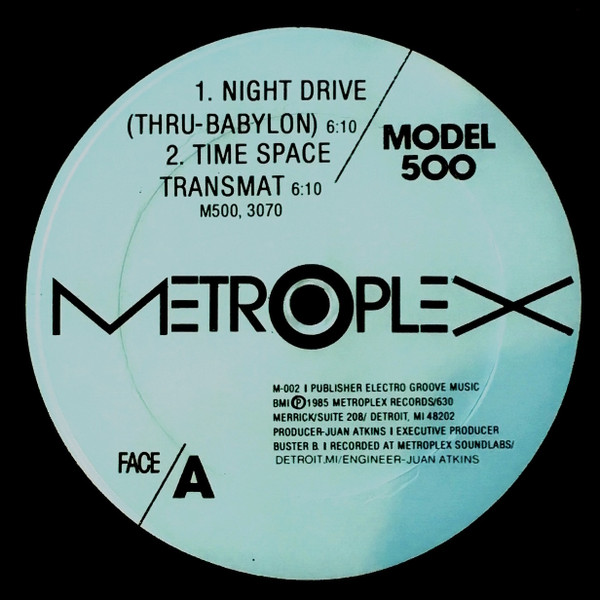
Then “Ocean To Ocean” and “Infoworld”. The latter mixed alien whistles, laser blasts and bleeps (7) with bursts of groovy, bionic, faux slapped bass (8). The former is a rattling, mechanised march with a message, where a mellower, melodic Juan, Marshall Jefferson or Harry Dennis-esque imagines a world of harmony. A place of possibility, where we call all be free (9). But “No UFOs” and “Night Drive Thru Babylon”, both old Cybotron tracks that Atkins took with him when that duo split in 1985, these still appeared to have been sent back from the future (10). Sparse, stark, stripped back machine funk. Shadowy, sinister, with icy, John Carpenter soundtrack synths. This was music made in “post-industrial” Detroit, where machines and technology – Terminator / Skynet-like – were already laying waste to the local job market and economy. Fast forwarding the city toward dystopia. When I heard DJ Colin Dale spin these records around midnight on then pirate Kiss FM, it was just how I’d hoped late night radio would be. Rebellious, underground transmissions from a distant galaxy. Calls for resistance, revolution, from tomorrow (11).
NOTES
(1) When I interviewed Eddie “Flashing” Fowlkes he was quick to point out that there was no first and second wave. Rather, everybody had been doing their thing, it was just that some got greater recognition faster than others. You only have to check the track-list of the “Techno! (The New Dance Sound Of Detroit)” compilation to see that Fowlkes is absolutely correct.
(2) There’s a pretty well known story that Atkins used to tell about Derrick May selling Frankie Knuckles his first drum machine. The way Magic Juan told it was that he, May and Saunderson, had incorporated drum machines – and so unique rhythms – into their DJ sets, and that they were the only people in Detroit doing this. May, short of cash, told Atkins he needed to sell one of the machines to make his rent and Atkins convinced him not to sell it to a local competitor, but to someone out of town, someone in, say, Chicago. This was Knuckles, who then began introducing his own programming into his playing at The Warehouse.
(3) I mean I had all the Second Summer Of Love hits that I’ve mentioned, and these were all from Detroit. I also had a copy of “Strings Of Life” – surely even the Boy’s Own editorial team owned that one. Atkins remixed “Strings” for its 1989 reissue.
(4) I bought my copy of “Clear” from Groove Records, in Soho, after hearing Tim Westwood play it on the pirate LWR. I worked at Safeway on Saturdays, so would travel into the west end on a Sunday. A lot of the stock would be gone, but so was the risk of getting “taxed” on the way home. I also had a soft spot for the moody, Visage / “Herr X” meets Hendrix the 12’s flip, “Industrial Lies”. It’s incredible when your young how quickly things move. In `83 in was in a group friends who listened to electro and span about on lino, but by `85 a lot of the gang had met girls, the “crew” disbanded, and I got into The Smiths.
(5) Was it “Blue Monday” or was it Donna Summer’s “Our Love”? Released in `86, this was Saunderson’s first record.
(6) Atkins also had a hand in May’s R-Tyme’s “Illusion”. My copy of this came from my other main techno teacher / dealer, John Kennedy, owner of Croydon’s Big Apple Records. Without John and Alex taking an interest in tutoring me I would have been clueless. Atkins and May also recorded together in `86, as X-Ray.
(7) Atkins’ productions were a big influence on the sound of FON Studios and Warp Records.
(8) Atkins started out playing bass in bands.
(9) I wonder if this was an influence on Gemini’s “Imagine A Nation”.
(10) The title “Night Drive Thru Babylon” was particularly intriguing. Remembering a Jockey Slut interview where Lucien Thompson from Bandulu told stories of driving Atkins around London with heavy dub booming, I assumed that “Babylon” was a roots reggae reference. I guess, in a way, it was, since the personal cosmology of Rik Davies, the other half of Cybotron, drew on The Old Testament, just as Rastafari does. The song has Davis heading down Michigan’s I-96 interstate, “driving in a black on black in black Porsche 924”. “No UFOs” is concerned with government cover up conspiracies, a la Area 51.
(11) This was a while before I learned of legendary Detroit DJ Electrifying Mojo, and how his eclectic, electric radio shows had been central in inspiring local music-making folks, like Atkins and The Belleville Three.
Written for the pioneer Juan Atkins, who sadly passed on October 31st.

Discover more from Ban Ban Ton Ton
Subscribe to get the latest posts sent to your email.

