On their 10 year trip, Be With have helped me personally by setting up several big interviews. Exchanges with artists such as John Rocca, Kimiko Kasai, Ned Doheny, Coastlines, Daniel Saxon Judd aka Sorcerer, and Jon “Ocean Moon” Tye. It was the long chat with Mr. Rocca that got me the offer of freelance work with the magazine Electronic Sound. The label have also reissued several records that landmark points on my own journey. Soundtracking a short period of big changes while living in North London…

I used to cane Andy Bey’s Celestial Blues in a former life. A life I lived in North London, close to thirty years ago. A life as a reformed raver, a rehabilitated Weatherall groupie, a stolen soul left damaged in Primal Scream’s wake. When I’d come out of hospital, when I’d finally managed to get out of bed, I faced nine months on three types of medication, and nine months dry. So began the process of re-inventing myself for the third time. I kissed the gear goodbye and took my waist length hair back to a crop. I hadn’t had it cut in at least six years, and the poor girl given the task kept asking, “Are you sure you really want to do this?” and then put it in a bag and asked me if I wanted to take it home. My partner, who I’d failed to inform, was so horrified that she fell to her knees and cried. I put five thousand records into boxes and took a fleet of taxis down to Reckless on Upper Street and traded in pretty much every 12” I’d bought between 1991 and 1994 for a considerable amount of credit. Italian scream ups, Progressive House, European Techno / Trance, it all went. I didn’t need the cash. I just wanted rid. I quit going to Flying and Boy’s Own affiliated events, stopped following Kris Needs and Alan Russell in Echoes, and started reading The Wire and Straight No Chaser. Listening to Gilles on Kiss. My enforced sobriety meant that I was now “free” to check out week night parties like “Space” and “That’s How It Is”, the Nuphonic Sundays at The Leopard, and my tab at Reckless was used to pick up a new “wants list” of classic jazz, funk and rare groove. Any real money spent was split between post-rock from Rough Trade, and anything I could find hanging around Soul Jazz (I’d say “hanging out”, but the only person who had any time for me was Willis (thank you, Hayley). Enter a ton of treasures from Russian Stooges 7s to John Cale & Terry Riley’s Church Of Anthrax, and Andy Bey’s Experience And Judgment.
With my “freshly” stocked shelves I managed to land a regular gig at the Medicine Bar, again on Upper Street. “Land” meaning that the lovely Rob Wheeler eventually buckled and took pity on me after receiving cassette after cassette. On a busy night I’d pestered him for a shot and he politely palmed me off with a “Do me a tape” not expecting to get one, certainly not expecting to get one every week until he said “OK”. Two of us would do the Saturday. My best mate, The Lizard, would bring the house and I’d bring the Andy Bey, Leon Thomas, Jon Lucien, Terry Callier, Gil Scott-Heron, Eugene McDaniels, Billy Paul, Weldon Irvine and Leroy Hutson.

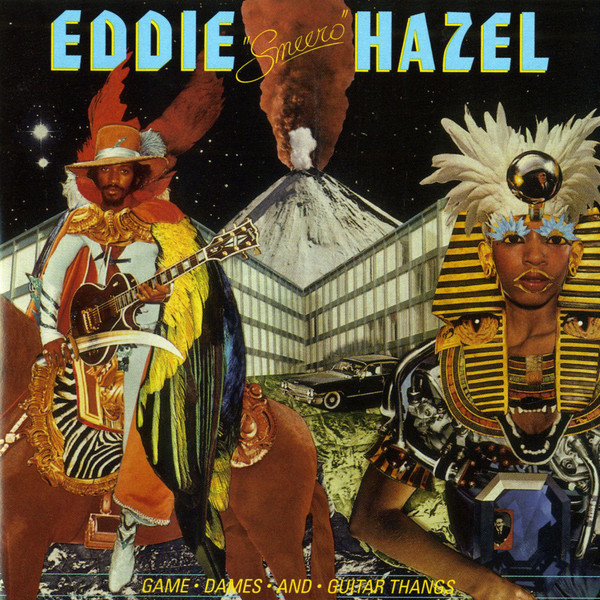
My introduction to Eddie Hazel’s Game, Dames & Guitar Thangs came at about the same time, but it was a discovery of The Lizard’s. He’d had his home kitted out with an amazing sound system. The sweet spot was the far right hand corner of his living room. You were so surrounded by the bass there that we christened it “The Womb”. When we weren’t DJing, whenever I could, I’d lug a sack of purchases over to Richie’s on a Friday night, with the aim of blowing him away / showing off, and blowing myself away by hearing them on that system. I’d spend the first hour or so teaching his kids to breakdance, and then when they went to bed, we’d smoke a little weed and sit generally speechless, but wearing huge grins in The Womb”, nodding in unison, sometimes laughing out loud at how impossibly great tracks were. I never wanted to go home. Everything sounded like the most fantastic recording you’d ever heard, but not much topped Eddie’s cover of The Mamas & Papa’s California Dreamin’.
I have a thing about California Dreamin’, have done since I first saw Wong-Kar-Wai’s Chungking Express. California for me has become a paradise disassociated from reality, a mythical ideal that perhaps may never be reached, but of which I can still dream. An eternal Shangri-La, a promise of possibility. I may one day get there. So I collect versions of the ’60s Flower Power hit whenever I find them. Eddie’s take is additionally charged by his own tragic arc.
Hazel has been far more important to me than Hendrix (not to deny Jimi any genius). At some point later, after another reinvention, I would start each morning with a loud Maggot Brain (a further reinvention would see this swapped for Cale, Conrad, MacLise, Young & Zazeela’s Day Of Niagara).

For a few people Lewis Taylor’s solo debut might be about the song Spirit – a multi-tracked a cappella, a hymn for the heartbroken, falsetto testifying, looking for love within. For most it’s Bittersweet that’s the big hitter. That’s the one the pop stars namecheck, the one that gets all the acclaim. The one where redemptive R&B overthrows its auteur’s demons and obsidian funk, graced by a bridge of gospel heights. For me, though, it’s all about Lucky. The click and the purr of close mic’d machines. Tom toms thumping like Johnny Favorite’s doomed, dark, voodoo heart. Guitar growling a guttural, Funkadelic, Maggot-Brain-ed, feedback squall. Lyrics concerning love, life, gone wrong. Listening to the lead, wah-wahed, riff, I’m back drawing on yet another laced spliff, watching its red embers, fascinated, as they burn toward my stained fingertips, unable to move.
“I see trouble, all down the line.”
Unable to move out of its way. Caught in the eye of an Eddie Hazel-esque hurricane. Unable to extinguish the anguish and palpable pain.
“Will this last for long?”
The song’s intro is so hypnotic, that it transports me so vividly to a particular point in time, that it’s narcotic, a drug. I can shift that feeling now with a simple shrug, but then everyday was like wading through its treacle-thick fug. Its soft, low, psychedelic, screams set to the pop and tick of a Shuggie Otis-esque beatbox. So fucked I didn’t know which way was up. Down, high, and strung-out. Aut Ah Mi Hed? You bet ya. In interviews Lewis himself talked of wilderness years lost, wasted, way more than stoned, in squats with nothing more than his guitar, playing live for the likes of Hawkwind. I hammered this at home, in my yard, in a mid-90s daze, living above an off-license on at the border of Highbury and Islington. Opposite the Union Chapel. No longer looking for the Balearic beat, but instead singing the blues. The song reaches for the light in its final third – finding salvation in a string arrangement to rival Marvin’s on Motown – but, desperate, narcissistic, and self-destructive, I still had some months, years, in the darkness to do.

The Lizard tells a story about how Billy Paul’s East changed my life. About how I fell under its spell and headed east myself. He says it’s why I married a Japanese girl, and why I ended up in Japan. I’m not sure that’s true, but it does mark a point of departure.
When I first heard Billy’s plea for travel to a more spiritual space I was recovering from a whole host of substance abuse issues. A creature of various unhealthy habits, camped out in the arse-end of acid house and the summer of love. A place populated by addicts and thieves. My lover, who was 5 years my senior, was still caning powders and pills. She’d go out on a Saturday night – leaving me at home – go dancing, and get high. I’d spend the week watching her crash back down – and then do it all over again. Sometimes she’d bring people back after the club and I’d lie in bed, pretending to be asleep, and listen to her moan about what a boring cunt I was now I was “straight”. Truth is I wasn’t straight, and probably never will be. I mean I don’t ever think about getting wasted any more, but the reasons I did, with such self-destructive enthusiasm, haven’t gone away. Probably never will. I wasn’t buying, or selling, but I’d go out with old friends, – like The Lizard – and usually I just couldn’t say no. After a couple of double vodka and Redbulls, it’d be little liveners, cheeky halves, one for the road, and then big fat white gaggers. This wagon’s wheels were super loose.
Gilles Peterson used to play East as the intro to his Sunday night show on Kiss FM. At the time he’d alternate between this and Vangelis’ Let It Happen, which is another top, top tune. Neither of them sounded like the “jazz” I expected Gilles to spin. East was “soul”, but it was way out there. Wind blowing, finger cymbals ringing and a rap that reminded me of that ’70s TV series, Kung-Fu, whose themes, however, had more in common with Alex Haley’s Roots. A song of slavery, and poverty, that begins like a prayer, on its knees, before launching into this irresistible frug for freedom. Woodwinds whistling above its bumping groove. The muffled, shuffled drums seemed so current. How could this have been made in ’71? The strings spiraled in and out, as if lifted from another record, another dimension, all together. I mean, it was so fucking strange, it was borderline deranged. “I wanna go east” sang Billy, and I just wanted to go anywhere. Anywhere away from where I was. It was a song of escape. Transcendence even, I reckon.
Gilles kept playing the tune, for a month, maybe two. Torturing those of us without a copy, or a clue where to find one. Creating demand. Supply arrived in the shape of a boot, the debut release on Moton Records. Disco re-adjustments by Diesel and Harvey. Executive produced by D. Jarvis. I’d tried all of my usual spots, but it was Kam in Mr. Bongo who actually came up with the goods. “It’s funny you should ask, ’cos somebody just a dropped a few of these off.” Bongo’s was THE place for hip hop, but they also stocked a small selection of fashionable house and edits – stuff that would be come to define the disco-not-disco genre-not-genre – which most of the crowd at the counter weren’t interested in. So slow-coaches like me could find copies of “cult” hits, like Black Cock’s 12 Inches Of Pleasure. Aphex Twin would pop-in and pick up Loft Classics.
The Moton pressing of East souped that shuffle up a smidgeon, transforming its pleas into a blast of brooding bashment for blues, beanos, and barn dances. A mating ritual music for strobe-lit, sweat-soaked basements. On its flip was a mad, live, dub, where elements of the original were whacked wildly in and out of the drum track. I bought 2 copies and self-indulgently span between them at my gigs at The Medicine Bar, on busy Friday and Saturday nights. Perhaps that’s why it came to be considered a theme tune of sorts.
“I ain’t got no love, and never, never, no peace”, Billy continued, as I charged towards a coke-assisted nervous breakdown. The Lizard, again, once said to me, “That’s it now, you’re cracked. You’ll never make it back”, and he was right. I didn’t make it back. I certainly I wasn’t the same. Perhaps that’s no bad thing. I had deliberately smashed myself to pieces – using a chemical deconstruction / demolition kit – in my quest for escape. When it came to reassembly, some bits were missing, some no longer fit. I’d never liked who I was anyway.
I guess my then relationship was the dictionary definition of toxic, for both of us, since I’d without a doubt facilitated her access to gear. Somehow I managed to summon the balls to end it before either of us died, and I set about that new start. We gave up the flat, and I moved in with my sister. I then resigned from my big pharma research job, and took an academic post at a hospital. The day I cleared my desk before going into work I dropped a microdot.

I was freelancing for a skateboard magazine, submitting records reviews, when Tommy Guerrero’s Loose Grooves & Bastard Blues came out. However, I knew nothing about skateboarding, and had no idea who Tommy was. I’d gotten the gig, instead, through my mates at the cult Brighton clothing shop, The One40five Store. Their connection with skate-associated labels such as Gimme 5, Silas, and its spin-off Tonite. I did a lot of my record shopping in Covent Garden, and especially the Rough Trade under Slam City Skates. I bought the album purely because the cover caught my attention, and because like a lot of their stock it was really cheap. I don’t know if they deliberately put a few “budget” priced copies of things in the racks to create a buzz, but I often thought the records must have the wrong stickers on them. I’ve just checked, it says 6:99. The guy at the magazine who hired me, Phil, an ex-skater himself, had just happened to pop into The One40Five when they were reading my poetry. I used mail monthly batches of things I’d written to friends. He was taken with something I done about hand-stitching a pair of Silas shoes, asked for my number, and got in touch. Boozing, while on the surface very different, we hit it off.
When Phil came round to my flat, and saw Loose Grooves & Bastard Blues, he said, “Oh shit, Tommy G! I was with him this week, showing him around. He’s doing a few shows. I interviewed him for the magazine. Man, you’d love Tommy! He’s just like you. Everywhere we went he was picking up flyers, tearing down posters. Collecting stuff for his collages.” The fact that this chap, Phil, thought of me as someone at least aspiring to be artistic, really makes me smile now. The walls of my Finsbury Park flat were covered in my artwork. I’d even framed some of it. In the move to Japan I must have thrown it away. Figuring that I’d always be able to make more. I used to stencil tees and sweats as well. I wonder where that time went.
We’d spend weekday afternoons in the sunshine of empty Finsbury Park pub gardens, drinking pints of Stella Artois. Phil’d open his backpack and take out a stack of CDs, scrounged during a morning round of record companies, and hand them over for me to review. He was effectively my first editor. Phil was the first person to show an interest in my writing, and he was a total stranger. He was the first person to ask me to try writing about music, and now that’s pretty much all I do. I’d given him a file containing copies of my prose, and he’d carry that with him, enthusiastically pulling out pieces. Showing me. “I love this one”:
“I took a short holiday from myself. Unfortunately now I’m back and doing the laundry.”
He’d tell me tales of snogging pop stars in Groucho’s, cock-blocking Steve Coogan, constantly name-dropping, all tall, all true, and then laugh fucking loudly when I appeared unphazed, unshocked. “That was supposed to freak you out!”
We’d visit Silas near Old Street and as I’d chat with the owner, Russell, Phil’d try on the new season’s gear, which he’d neither put back or pay for. We’d visit Rough Trade and the staff’s faces would just drop. Though Dave from Buggersod, behind the counter, would hand him bits when no one was looking. Domino would give us passes to cover gigs for bands like Modest Mouse, and we’d get thrown out for heckling. Well Phil would heckle and I’d feel obliged to back him up. One of his claims to fame was dry humping Ian Svenonius on stage.
He’d come and watch me DJ, and then sleep on my floor. Borrow / pinch my CDs. We’d both dance to Labi Siffre’s I Got The, but we were the post-rock posse. He loved June of 44 and I had friends at FatCat. Both of us were trying to change destructive habits, to be better people, but neither of us was really succeeding. Nigo’s Freediving always, always makes me think of Phil.
We’d give the magazine pieces on Shellac, Fuzagi, Mike Ladd, and Cannibal Ox. Phil’d moan about the rise of finger boards, complain about the demographic, and say that what they really wanted was Britney and the Spice Girls. He’d been a professional, a champion, as a kid. Then he got injured, and then he got too old. He’d regret dropping out of school, and I’d worry about him. Then he disappeared.
Be With Records’ Joyride / Labour Of Love 10th anniversary package can be ordered direct from the label’s website.

Discover more from Ban Ban Ton Ton
Subscribe to get the latest posts sent to your email.
 Ban Ban Ton Ton